Sara Shea – Parchment

Parchment
by Sara Shea

Title: Parchment
Medium: Parchment, New Inks
Artist: Jacob Hugh
2074 – 2120

This museum wing contains “Parchment”, masterpiece created by artist Jacob Hugh. “Parchment” is exhibited behind climate-controlled casing, guarded by military personnel and monitored by twenty-four hour state-of-the-art surveillance. Photography of any sort is strictly prohibited. Please remain behind the velvet ropes and supervise children. Once you have viewed “Parchment”, move to your right, so others may have their turn. Proceed into the corridor and board the travellator, which will transport you through halls displaying panoramic 3D footage of scenes from Hugh’s life. Debark in the South Wing. Exhibits of historic photographs, videos, media clippings, memorabilia, ephemera from Hugh’s estate, and interactive displays are housed in the South Wing. Do not re-adjust your earpiece. Your multimedia guide will automatically correspond to your shifting location within the museum. To pause the narration at any point, simply think of the color red. Think of green to re-start.

Be sure to visit the gift shop. Holographic clones, body scan magnification apps, documentaries, accessories, holographic skin suits and temporary appliqués are all available for purchase.

***

The Colorful Life of Jacob Hugh
2074 – 2120
Multimedia Biographical Guide

Jacob Hugh’s masterpiece compares to works by Michelangelo, Escher, Klimt, and Warhol. In his lifetime, Hugh became one of the most influential and highly valued artists in history. Born in Tahiti in 2074, Jacob Hugh was the only child of courtesan and political spy, Cora Hugh. Scholars and critics place great emphasis on Hugh’s earliest childhood years in Tahiti. Captivated by color and light, Hugh often described his childhood as “a kaleidoscopic realm where tanagers and iridescent parakeets flickered in emerald jungles; where prismatic fish drifted through aquamarine seas, and sunsets the colors of frangipani flowers gave way to phosphorescent tides and starry nights.”

The identity of Hugh’s father is unknown, although academics surmise he was of Polynesian descent. Little is known regarding the true identity of Hugh’s mother, Cora. There is evidence she served as a social media savant and undercover geo-tagging analyst for the French Government. She held passports under several pseudonyms. Regardless of her mysterious origins, there is no doubt Cora Hugh was a cultured, intellectual woman. After leaving Tahiti, Cora traveled extensively with her young son, residing intermittently in luxury apartments and finest hotels of Paris, Milan, Berlin, Qatar, Rome, Singapore and Bangkok. She hired an elite contingent of private tutors to educate her gifted son.

Nurturing Hugh’s early artistic aspirations, Cora spared no expense on the finest paints, pencils, tablets and graphics programs. Though Cora never enrolled her son in any traditional school, she equipped him with an eccentric but extensive discipline in the visual arts. In interviews, Hugh later admitted that his mother had “frequently vanished for days, or weeks at a time, with no explanation.” When tutors or other caretakers were unavailable to look after Hugh, Cora deposited her young son in the halls of museums and art galleries, instructing him to memorize works of art. Jacob Hugh credited his unusual upbringing as the foundation and inspiration for his masterpiece.

By age nine, the ambidextrous Jacob Hugh was producing accurate reproductions of works by DaVinci, Escher and Klimt– entirely from memory. Most of these early works were lost in a fire that ravaged Cora Hugh’s Milan apartment in 2087. Recently, however; five of Hugh’s exquisite sketches were discovered in a safe deposit box that his mother purchased in Paris in 2085. Four of these original drawings sold for over fifty million dollars a-piece, in a Dubai auction. The fifth drawing is now displayed in the South Wing of this museum.

Cora Hugh died in London in 2089. Medical records cite her cause of death as an overdose of barbiturates and alcohol. She was thirty-seven years old. Whether this overdose was accidental or intentional is not known. Regardless, the tragedy left Jacob Hugh orphaned at the age of fifteen. He began work on his masterpiece that same year.

Funded by a considerable inheritance, the grieving Jacob Hugh returned to Polynesia, where he apprenticed himself to a traditional tattoo artist; a Samoan Chief named Tyrian Freewind. Under the guidance and tutelage of Freewind, Hugh gained recognition as an emerging tribal tattoo artist. Hugh inked the initial tattoos on his own arms during that period in Polynesia; elaborate bands of geometric designs that morphed into scales of coiled serpents circling his biceps.

Hugh’s quest for enlightenment, his passions for art and adventure, led him from Polynesia to India. In 2093 He traveled from Calcutta up the Ganges River to Bangladesh and Delhi, studying with various Swamis, learning the practice of yoga, the art of henna and godna tattoo. Shocked by the extreme poverty he found in cities along the Ganges, Hugh gave away his inheritance to the children, the poor, the sick and hungry of India.

He trekked on toward Nepal, traveling at times by foot, by bus, by camel and caravan. He became disoriented and lost in the Himalayan Desert during a sandstorm. He suffered dehydration, starvation, extreme exposure to sun and wind, and early stages of photo keratitis– desert blindness. His sunburned skin began to peel. Distinct hues and colors of the surrounding desert began to blur, fading slowly into a vast white light. When death seemed most certain, Hugh came upon an ancient formation of metamorphic boulders; fantastic geological forms, eroding in harsh desert weather. The boulders offered shade, protection and relief from violent winds.

Hugh discovered a gnarled pomegranate tree growing safely in a rock fissure amidst the boulders. The miraculous tree bore one ripe fruit. Hugh survived for seven days, curled within the fissure, staving of starvation by rationing his consumption of pomegranate seeds and blood-colored juice. On the seventh day Hugh was rescued by Tibetan monks, who found him and carried him to the safety of their Zen Monastery. Under the care of these monks, Hugh recovered his strength. His vision and perception of color slowly returned.

Hugh adopted Buddhist practices of the monks. He shaved his head and donned a monastic robe. He spent the year of 2094 with the monks, fascinated in particular, by their tantric art of sand mandalas. Hugh assisted the monks in gathering substances used to create the mandalas; colored sands, granules of lapis lazuli and ruby dust. He helped the monks to collect desert flowers; first drying the flowers, then employing mortar and pestle to grind blossoms into colorful powders. He knelt with the monks, painstakingly arranging colored grains into elaborate patterns.

Hugh identified the moment of his spiritual awakening as a day in the monastery: “I balanced a single indigo grain of sand in the palm of my hand,” Hugh explained in later interviews “admiring it in rays of golden sunlight. Suddenly, I saw my whole life reflected in that grain. As Himalayan wind swept the grain from my palm, I understood the purpose of my life.”

Hugh parted ways with the monks, traveling on to Paris and Amsterdam where he served brief stints of employment in various tattoo parlours, inking under the pseudonym T.J. Windhue. During this period (2095-2098) Hugh began to experiment with inks, pigments and carriers. He began an extensive correspondence with European and Asian ink manufacturers, as well as other notable tattoo artists. He began developing recipes.

In 2099, Hugh rented laboratory space in a science building owned by the Berlin University of the Arts in Germany. (Hugh’s early notes, along with sketches and recipes for his masterpiece, are exhibited in the Berlin University Gallery.) In Berlin, Hugh began importing small quantities of heavy metals; cadmium, chromium, cobalt, barium, cinnabar, as well as azo chemicals. He corresponded with chemists and gemologists, obtaining dust from finely crushed Aubergine Tahitian pearls, jadeite, black opals, blue garnets and various precious gems. He experimented– mixing platinum, silver, copper and crystalline gold dust; with rare earth elements, ultra violet pigments and liquid crystals. He refined recipes for carriers and binders. All the while, Hugh funded an elite team of Berlin University engineering students, whom he’d commissioned to develop a laser-precise tattoo gun.

Over the next year, Jacob Hugh illustrated his chest with stunning layers of tattoo; silver dust, aquamarine, indigo. He captured dazzling waters of the south Pacific, adding images of tropical fish, sea fans, starfish and turtles. He etched an over-layer of ultra violet ink, until his chest and shoulders glowed with a phosphorescent aura. On the rippling surface of ultramarine, just over his heart, Hugh inked a portrait of his mother. Her gentle face floated faint, diaphanous; as though distant and viewed through deep water. Some critics claim that Hugh mixed his mother’s ashes with various ink pigmnts and silver dust to achieve her vitreous portrait.

The complexity of Hugh’s project evolved as he illustrated his body with memories of his fantastic travels. Phosphorescent waters of the South Pacific spilled down his torso, swirling into darker waters of the Ganges River, which ran the length of his left thigh. Faces, exquisite portraits of his spiritual leaders, shimmered like holograms emerging from dark currents of the Ganges.

The Himalayas rose along Hugh’s shoulder blades, jutting into a pale blue sky at the base of his neck where desert wind swept grains of sand into thin air. Brilliant dots of color rose up the back of Hugh’s neck, gathering at the top of his skull and swirling into a more cohesive pattern; the edge of a mandala. It took Jacob Hugh seven years of painstaking work—dot, by dot,—to complete the tattoo mandala that eventually covered his entire face.

There was no anonymity for Hugh once his facial mandala was complete. In the streets of Berlin, people stared. Media and paparazzi pursued him, demanding interviews, answers and explanations for his unbelievable art. Tattoo artists begged Hugh to publish his innovative ink recipes. His Berlin laboratory was burglarized.

In 2101 Hugh retreated to a small island off the coast of Greece, where he continued to work on his masterpiece; adding mysterious neon inks to illustrations of urban streetscapes and skylines of Paris, London and Amsterdam that ran the length of his forearms. But public curiosity could not be satiated. Finally, in 2102, at the age of twenty-eight, Hugh agreed to an interview and photo shoot with a young reporter from the London Art Review. Then came the exorbitant offers. A preeminent gallery in Basel, Switzerland offered Hugh one million dollars to pose, nude, for three days in their gallery, in conjunction with the opening events of Art Basel. Hugh accepted the offer.

Art critics went wild. Those who saw Hugh in the flesh during that first exhibition described the experience as pure rapture. They claimed his flesh “glowed and glittered; as if he’d been dipped in stars.” They praised his elaborate designs of sea creatures that morphed into Escher-like tessellations. They described his facial mandala as mystical, breathtaking, holographic; a layered millefiori of vibrant color. The medical community voiced concerns regarding toxicity of ingredients in Hugh’s inks. The public demanded more showings of Jacob Hugh.

Some critics proclaimed his art as genius, revolutionary, the future of modern art. Others condemned him as a grotesque, deviant, circus freak. A prominent gallery in Rome invited Hugh to display his nude body, but the Vatican forbid the exposition and censored all media coverage. Protests, strikes and riots ensued in the streets of Rome.

Hugh was awarded a Guggenheim Fellowship in 2105. Prestigious art schools bestowed honorary degrees upon him, inviting him to teach and lecture on the intersection of Ethnographic art and Modernism. Once again, Hugh began to travel. Miami, New York, Los Angeles, Madrid, Moscow, Cairo, Mexico City, Stockholm, Buenos Aires, Lima, Cape Town, Sydney. Galleries, museums, and art institutions worldwide scheduled exhibitions of Jacob Hugh. All the while, Hugh embellished his masterpiece. To him, it was always a work in progress.

Hugh took great pride in inking himself by his own hand. He commissioned a select group of renowned tattoo artists to assist in completing his designs on areas of his body he could not reach. There was ink between his toes, on the soles of his feet, his tongue, his gums, his earlobes and eyelids, the corneas of his eyes, his genitals. He had his fingernails and toenails sliced away, in order that he might access and illustrate the pink ovals of empty flesh below. Fine art photographs and nude videos of Jacob Hugh circulated through the Internet, appearing in pornographic websites and erotic publications worldwide. Much debate centered on Hugh’s illustrated genitals.

A pomegranate tree rose from Hugh’s loins, its windswept branches arced the length of his penis. On the right side of his scrotum, an ancient boulder shielded the tree from desert winds and gold rays of a neon sun that stretched over his right hip, blazing into his abdomen and pelvic region. On the left side of his scrotum, a fragile branch bowed with the weight of a single, crimson pomegranate.

While visiting China in 2107 to lecture at a Beijing university, Hugh disrobed in a public park, exhibiting his tattoos to a group of art students. He was promptly arrested and imprisoned. The President of the People’s Republic of China chastised Hugh, labeling him as “vulgar, perverted . . . masochistic.” Hugh spent forty days and nights in a communist prison while international governments negotiated his safe release. This experience likely led to Hugh’s addition of the gleaming metallic handcuffs he inked around his wrists. He was banned from China, Saudi Arabia, Iraq, Israel, Syria and several other countries. Media coverage of his artwork was censored in Cuba, Venezuela, North Korea, Sudan and Turkey. Hugh was offered political asylum in America, and granted American Citizenship through Refugee Status.

Hugh became the wealthiest man in the world. He achieved status in The Guinness Book of World Records in 2109, as the most tattooed human in history; creator of the world’s most the vibrant tattoo art. He was celebrated as “a man who stood beyond the bounds of race and skin color… beyond categories of ethnicity.” With funds raised from exhibitions, he launched art schools, galleries, elite tattoo parlours, color research corporations, environmentally responsible ink manufacturers, progressive advertising design firms, and art museums. He brought art schools, art initiatives and museums to far, impoverished corners of the globe.

In 2111, at the age of thirty-seven, Jacob Hugh was diagnosed with the HIV virus. American tabloids claimed Hugh had contracted the virus from a homosexual lover in Tahiti. Those rumors were never substantiated. Art critics now claim that the virus came from an infected tattoo needle. Hugh sought treatments; but the virus quickly progressed into AIDS. Lesions began to rise through the ink of Hugh’s priceless masterpiece.

The public clamored for a cure for Jacob Hugh. Hugh donated billions to research and pharmaceutical companies in search of a fast-acting cure. He agreed to serve as a test subject for a new, experimental AIDS antidote. In an unprecedented, internationally broadcast reality television series, Hugh shared his real-time experience with AIDS and the experimental antidote. Fifty Hues of AIDS became the provocative, reality television series of an era. The visceral series ushered in a new genre of reality television. Reality Pharmaceutical Trials: Cures and Futures. Real People, Real Progress: Yesterday’s Epidemics and Tomorrow’s Drugs.

The AIDS antidote was hugely successful. In a matter of months, Hugh was entirely cured. He was awarded the Nobel Peace Prize. Time Magazine honored Hugh as Man of the Year, and published his iridescent face on their cover, along with the caption “The Man Who Became Art, the Art That Became the Cure.” Jacob Hugh became the spokes model and avant-garde advertising campaign for the pharmaceutical company that patented the antidote. Hugh honored the young biochemist responsible for discovering the antidote, by illustrating the man’s portrait on the palm of his right hand. The pharmaceutical company copyrighted the slogan; “Let’s give a hand for the cure!” running that tag line, accompanied by their logo; across a photograph of a joyous and grateful Jacob Hugh, applauding. The advertisement became an icon for changing times; end of an epidemic.

Produced from a particular genetic protein found only in a near-extinct species of deep-sea starfish, the AIDS antidote was prohibitively expensive; only available in the United States, and only in limited quantities. As scientists worked frantically to duplicate the protein synthetically, distribution of the antidote became the hugely controversial issue. Distribution was carefully controlled by a new, government-run, health care initiative. Waiting periods were lengthy. Applications for the antidote were processed in order of most-to-least extreme AIDS cases. In a backlash against the government health care act, Hugh voiced concerns and protests, advocating for the establishment of privatized antidote distribution centers.

As Hugh’s fame escalated, so did concerns about his safety. Everywhere he went, people wanted to touch his radiant skin. He was mobbed in the streets by fanatics. In 2116, The U.S. government required Hugh to employ body guards. While visiting the Caribbean in 2117, Hugh was approached by a masked man carrying a vessel of battery acid. Fortunately, one of Hugh’s body guards wrestled the would-be attacker to the ground in the nick of time. Both the body guard and the attacker were grotesquely scarred and disfigured in the incident.

Following the horrific attempt on Hugh’s life, the government designated Jacob Hugh as a National Treasure. The government demanded a halt to Hugh’s international travels and placed strict restrictions on his passport. Hugh vehemently protested these restrictions. He went into hiding in the mountains of northern Idaho, refusing to exhibit his masterpiece, granting only radio interviews.

Over radio broadcasts, Hugh proclaimed; “Below the ink, I am no different from anyone. My skin is merely my chosen media for recording my life story. Freedom of artistic expression and freedom of travel are imperative to my journey. I need to be with the people! I must share a masterpiece symbolizing transformation of my life journey into spirit. My art is merely a map and archive of my time here. I must travel and teach about the impact of art and ideas on social consciousness.”

Eventually, the American government lifted restrictions on Hugh’s passport, assuaging him with a private jet to assist in his international travels. Hugh immediately scheduled a retrospective exhibit in Tahiti. En-route to Tahiti from LAX, on May 1st of 2120, Hugh’s jet was hijacked. The jet vanished entirely from tracking systems. And Jacob Hugh disappeared.

Hysteria rocked the world of modern art. IT ON Had Hugh been kidnapped?IT OFF The FBI and the CIA launched an extensive investigation. Art critics raised the possibility that Hugh had grown weary of fame, fortune and publicity . . . and finally staged his own disappearance.
Two days afterward, the President of the United States addressed the nation; revealing news that the White House had received a ransom note. Hugh’s captors demanded that billions of dollars in U.S. aid be funneled to key embargoed countries. His captors demanded a lifting of certain U.S. trade restrictions. And, they demanded a supply… of the limited antidote. The terrorists would guarantee the safe return of Jacob Hugh, only after their demands had been met.

An emergency UN summit was held. Negotiators were called in to work with the terrorist. U.S. embargos and trade restrictions were temporarily lifted. A medical distribution task force was readied to transport the sensitive antidote to an undisclosed location on a moment’s notice. As the nation endeavored to appease the terrorists, the FBI traced clues regarding Hugh’s kidnapping and whereabouts.

Seven days after his disappearance, FBI agents located Hugh and his captors on a tiny island near French Polynesia. Employing satellite surveillance and body scan technology, FBI agents pinpointed the unmistakable glow of Hugh’s elaborate tattoos. In a secret meeting, on May 8th of 2120, the President of the United States authorized a covert operation to liberate Hugh from an island prison guarded by terrorist kidnappers. FBI agents and SWAT teams planned a night raid to overtake the compound.

But something went amiss, in the jungle, on the dark tropic night. A flock of florid parakeets startled one of the kidnappers. Two American Green Berets and an FBI agent were killed in a sudden burst of machine gun fire. Remaining SWAT team members opened fire and took the compound by storm. But they were too late. In an apparent suicide pact, Hugh’s captors had taken their own lives, as well as the life of their hostage. A single bullet to the chest had pierced Hugh’s heart, as well as the diaphanous portrait of his mother, Cora.

Hugh’s body was flown to a forensic morgue in Washington, DC. As news of his death made its way around the world, investigations and international litigations were launched against the U.S. government. Italic on Had the government covered up crucial information? Mystery, controversy and conspiracy theories swirled as the world mourned.Italic off Memorial services were schedule in Tahiti, Nepal, India, France, Germany, the US, and an array of other countries.

Hugh left no heirs, and no known family. As lawyers struggled to untangle Hugh’s estate and assets, several countries began to argue over his body. Tahiti petitioned for the return of their native son. The U.S. upheld Hugh’s status as an American Citizen and National Treasure. Monks from the monastery pleaded for a traditional cremation ceremony in the desert. The Pharma Company that had cured Hugh of AIDS, produced and publicized a document Hugh had signed; donating his body for exclusive, scientific research by their company.

“Who Owns the Late, Great Jacob Hugh?” ran headlines of the International Herald Tribune. Litigation dragged on for months as Hugh’s body lay in cold in the morgue. Finally, the case reached U.S. Supreme Court. In a landmark ruling, the Supreme Court initiated the process of dividing complicated ownership of Hugh’s body. Hugh’s skin was granted to the U.S. Government as a National Treasure, under conditions that his flesh be removed and adequately preserved by a select team of medical experts and parchment archivists. Hugh’s internal organs became property of the Pharma Company, on conditions detailing the transport of all bones and unused parts to a grave site in Tahiti and a Monastery in Nepal.

***

Today, millions of guests arrive annually to experience “Parchment.” Many describe the journey as a pilgrimage. Those who knew Jacob Hugh in his lifetime claim that the priceless “Parchment” has lost its once vibrant glow. Yet, children, who never knew Hugh in the flesh; marvel at its fresh, halo-like aura. Italic Every visitor describes different sensations, different experiences with “Parchment.”

Some visitors are fixated by the colors, vibrant hues, designs and patterns. Others seek meaning in the timeline of geographic travels. Some are awed by its potential to influence and impact. Some express horror, disgust, guilt and shame; or anguish, denial and grief. Still, others experience healing and spiritual awakening. Many admit their perspectives on “Parchment” are dynamic and shift over time. Most express concerns that despite all efforts toward preservation, “Parchment” will ultimately crumble to dust.

This concludes your multimedia tour. In an effort to further this exhibit as a progressive, educational and interactive experience; the museum offers feedback stations. We invite you to reflect, share and upload your responses to “Parchment” in the guest tablets provided.

Thank You for Visiting “Parchment”

—————————————————————————————————————————————————————
—————————————————————————————————————————————————————
—————————————————————————————————————————————————————
—————————————————————————————————————————————————————
—————————————————————————————————————————————————————
—————————————————————————————————————————————————————

END

***
Wendy Gist – Crossing Lines

Crossing Lines
by Wendy Gist

     low-sky country
tortilla-white clouds crossing
Arizona
             red-garnet cliffs
drifting like strung pearls
on the nape of jade sky
     auric light
             blooms noon
silver-blue brushed hills and
sunflower lavished heat shine
             raven eye
                  shared
               as
       hitchhiker leans against plywood
sign STEAM CORN
rug woven roadside
         blue-denim clothesline
             free-range graze
royal royal blue
lake moves in puerperal
              silence

Philip Gross – Ten Takes on the Garden

Ten Takes on the Garden
by Philip Gross

It could, I quite see, grow on you:
the seduction of melancholy. A deciduous
emotion, longing to be mulch.

*

The corkscrew willow: every inch a nervous tic.
How much of what we prize –
Exquisite! – is deformity?

*

Or the shrill of a New England (dying,
dying) Fall – its annual opera. Car-loads
turn out to be ravished by magnificent distress.

*

A garden inclos’d… Outside, the soft
lathe-hum of traffic is part of the point:
that is there. And therefore: this is here…

*

… which might be tragic, if we didn’t half
believe this is the real, right world – the rest,
at best, approximation and at worst, mistake.

*

The mechanical birds of the Great Khan’s
pleasure garden? We have moorhens
ticking over the pond, with rusty squeaks.

*

How subtly crushing is the ruthless calm
of ducks (when they’re not panicking,
that is). We are dismissed by it.

*

And as for Nature? Where more satisfied
than this: the cut stump rotting, liquefying almost,
larvae hard at work on softness, little guts.

*

Where were we? Treading water.
Damp rises. Gravity sucks. And we’re busy
just keeping our heads above ground.

*

When the wind blows, rashly coloured scraps
of children scatter in among the leaves
or vice versa, who knows which is which.

Woodbrooke Quaker Study Centre, Birmingham.

Jim Davis, Jr. — Sunday on the Piazza, Early April, Year of the Horse

Sunday on the Piazza, Early April, Year of the Horse
by Jim Davis, Jr.

Lavender drapery, abandoned armoires from Rotterdam, Versailles,
caught in the roots of a river, mislaid in the wake of a police boat.

Gulls down now and then from the factory’s tin roof, carving
air, land in swells of an unseen current, known only by its surface

disturbance. Gulls in the vestigial tail, broadening shadow of sky
scrapers, meat packing plants come antique furniture purveyors,

as trees behave like synapses, whose seeds made the sideways trip
from Pottawattamie territory, moved in human patterns, patterns

of forgetting, reaching upward, nearing nothing, down to the swell
which is the current’s only note, supreme magnetism, unseen

careening over smooth stones. The boat shines its light on a body.

Scott T. Starbuck – Of Whales and the Hinckley Hunt on Christmas Eve, 1818

Of Whales and the Hinckley Hunt on Christmas Eve, 1818
by Scott T. Starbuck

“An 1890 engraving depicts the Great Hinckley Hunt of 1818. Nearly
600 men participated in the Christmas Eve hunt, which bagged 21 bears,
17 wolves, 300 deer and untold numbers of turkeys, foxes and raccoons.”
Mark J. Price, Akron Beacon Journal, December 22, 2013

The spring after the 1818 massacre of corralled Ohio wildlife
there were no wolf howls under a full moon,

no red fox flashes at dawn,
no pesky bears harming fences and livestock.

With predators gone and deer out of fields,
farmers had a better chance of survival.

It was reported they sang, told stories,
and filled bellies with game.

It was a different world then
with different pressures and habits

like how my ancestors, 800 miles east,
shipped out to kill sperm whales,

risking huge toothy jaws
that killed or crippled thousands.

The Treaty of St. Mary’s had been signed in October
dooming the Myaaniaki Tribe to Oklahoma Territory

and Christ child was safe in manger.
Bear and whale fat dripped off hair and faces.

Buzzards gathered.
Chickens and sheep would be safe.

Pat Seman – Black Tree

Black Tree
By Pat Seman

The sea, the hollow booming sea and that cottage
we once rented with the window wide open
         and the black tree against the dawn,
its long branches with joints like an old man’s knuckles
                                                                                               reaching in.

The wood creeping into life behind us, scarlet
   rags and threads of mist caught
                                            on the branches.

Who would have thought that beyond
   lay such a spread of green, of fields
         and hills and a river between steep banks winding
and turning back upon itself.

The sense that it will never end, this returning
         to the same point.

Skull of a goat on the dirt path.

Even the poorest bone can sing, catch sighs
   of the sea and the wind
through apertures bent and curved.

There are spaces between us; without touch,
   without the slow, steady breathing of body against body,
joy must stay jarred and crystallised,

when so much is near and all around
   for the picking; fruit like jewels
that hang from the old gnarled branches—death

reaching out his fingers,
   the gift his fingers, an alphabet of sound.

   Stones flash as he touches the piano keys.


Another Island by Bob Ward. Copyright 2014 by Bob Ward. All rights reserved.

Another Island by Bob Ward. Copyright 2014 by Bob Ward. All rights reserved.

Ken Saffran – Last Brother

Last Brother
by Ken Saffran

She asked me to come with her to this frozen field
while she walks the ruins of her childhood.

             I imagine days with long grass, with lots of snow,
             follow her bootprints back in time.

The house used to be
                                          here
all that remains is a cement step.

The barn abandoned, roof caved in
by heavy snows and summer thunderstorms,
                                     but mostly from neglect.

This really is all passersby can see.
So few people use this road
the locals would slow down and wonder

             a man standing by a car in winter
             a woman walking through a long empty yard

No matter how I may use words
that world is beyond reach. Only light
harvests the tall brittle weeds.
Old fences overgrown,
vines coiled about each post,
the wire rusted or broken with its past.

             We sit a moment in the car
             still warm enough to not show our breath

The sky is falling slowly again.

Andrea Rubin – Infestation Diary

Infestation Diary
by Andrea Rubin

Tweet and chirp these days i fear the mattress the closet the chair my own foot glimpsed peripherally i begin the days with fecal analysis is the material small large cylindrical rounded pellets rice beans pointed does it belong to a flea a mouse a coyote a cat a train in the distance belts out a louder scratching behind the bedroom wall and birds tweet there too to greet the morning and then night. i hover above the contaminated floor my toothbrush lies quarantined in the refrigerator a moth wobbles past me i scream

Philip Gross – Oh, So That’s Where We Were Going

Oh, So That’s Where We Were Going
An Interview with Philip Gross
by Bryan R. Monte
Copyright © 2014. All rights reserved.

Philip Gross is a prize-winning British poet, novelist, short story writer and university lecturer with more than 15 titles to his name. In 2009, he won the T.S. Eliot Poetry Prize for his book, The Water Table. In 2010 he won the Wales Book of the Year, and his next book, Deep Field (2011), won a Poetry Book Society Recommendation. His most recent book, Later (2013), continues Gross’ reflections on the limits of language, the liminal, fragile places around England’s rivers, estuaries and coast, his father’s death, and the physics and metaphysics of the social and natural universe. In this interview, he explains his development as a writer, his most recurring themes, his writing discipline and future projects.

Bryan Monte: With more than a dozen poetry books and six poetry awards, including the T.S. Eliot Prize, some people might think you began writing when you were quite young. How old were you when you first began to write poetry?

Philip Gross: I was 13 or 14. Prior to that, I had been writing stories. I’d been doing that since, oh, I don’t know – as long as I could hold a pen and write.

BM: Why did you begin writing poetry—for a school assignment or a family occasion or after hearing another writer read?

PG: I was writing a spy story, and there was this character in it, who was a diplomat and a poet. I thought: ‘why not try to get inside his mind a little by writing one of his poems?’ So I did. I never completed the novel, but the character, who wrote the poems, turned out to be… me. I wrote poetry for five or six years, until I went to university to study English. Then… That’s another story.

BM: Where was your poetry first published?

PG: In my school magazine. (Since this was the 1960s, it was an alternative magazine my friends and I, from several schools in Plymouth, started). Some of the poems were performed by a rock band we created too.

BM: Did you continue to write mostly for your own amusement or as an intellectual exercise?

PG: Oh, never just an intellectual exercise. When it threatened to become that, at university, I stopped. Besides, studying at university gave me politics, and some of the critical theory that made it easy to feel superior to the actual business of writing poetry so I thought ‘Why do it?’ There seemed to be more important serious things in life. In fact, the writing also found an alternative channel—alternative, that is, to my state of mind in those years. I wrote songs. Not many years after that, life caught up with me, in the form of becoming a parent—being there at the birth. And you know what? I found I needed poetry again.

BM: Name two or three poets you admired and read when you were young and how you think they influenced your own poetry.

PG: T.S. Eliot’s Waste Land was the first thing to kick me into wanting to be part of that world where I knew the words and images were moving me before my mind could grasp their meaning. In hindsight, certain cadences of classic poetry always physically affected me, but that was as a reader. It was the Eliot that made me need to be part of it.

It also led me into all kinds of haughty solemn mannerisms and a kind of prematurely middle-aged posture that needed to be shifted. Some of the ‘Liverpool Poets’ of the late Sixties helped to do that—a faint British aftershock of the Beats, in hindsight… and not an influence that lasted. But it did a job for me then. I do think writers seek out reading like animals seeking out nutrients in the landscape, by taste and instinct, dimly knowing what will rebalance an imbalance or answer a lack.

Ted Hughes was more substantial, with his combative nature poetry, a feel for the energy locked up in life and language. But all this was in the teenage phase, before the dormant time of university. Afterwards, I’m grateful for finding the different, warmer Modernism of Basil Bunting’s Briggflatts, the scientifically-informed surrealism of Peter Redgrove, then the shock of finding that form could be startling rather than consoling, in early Geoffrey Hill … and finally the gracious but raw address to history in Seamus Heaney’s bog poems in North. OK, by then I wasn’t ‘young’ any more – this was my late twenties … but it was a kind of second writing-birth.

BM: Do you remember any song lyrics or themes you wrote for your band that were reiterated later in your poetry? If so, are there any you are still concerned about today?

PG: What stays with me isn’t the words, mainly those of a reasonably gifted adolescent fighting his way through thickets of pretension. It’s the experience of making the music together—still one of my gut-level models of good collaboration. None of us were gifted musicians but just once in a while something passed around the space between us, almost physically lifting us to play better than any of us could play.

The singer-songwriters I came to admire weren’t much like what we played; they were the likes of Bob Dylan, Leonard Cohen (always sharper and gravely wittier than people tended to think), and Joni Mitchell with her way of twining effortless speech rhythms round the lines of music like ivy round a tree trunk. Later, Tom Waits, with his endlessly unsettling blends of surreal and sentimental, his weird ventriloquisms. All the men, at least, were anything but tuneful singers, but they had voice; it was the music of voice I liked… and still want that in poetry.

When I performed years later with an improvising, free-form band called Vanilla Allsorts, it was in spoken poetry, not song—words having a conversation, on their own terms, with the music round them. If anyone wants a clue to ‘hearing’ my lines on the page now, they could try thinking of the natural syncopations of voice rhythm growing round the musical beats of a line.

BM: Do you think that growing up in Cornwall inspired the recurring setting and theme in your poetry for the coastal landscape and (vague) borders?

PG: I was born in Cornwall and grew up in Plymouth… already a borderline—a real one, marked by the river Tamar with, at that time, only two chain-ferries crossing it. But the granite moors, with bogs and sudden clefts and rock-faces, on one side … and the sea on almost every other side. Yes, that sense of a physical place has always been there, and it’s still my inner landscape … even though I could never say simply where was home.

My mother’s family was Cornish, a long line of Methodist lay preachers, working in a saddler’s shop … but my mother’s father had been born in British India, blown to these shores by the First World War … (curiously like the way my father was brought by another war, another kind of exile.) I wrote a lot about it early on, then not, or not explicitly … and I have a feeling there is more to say about it now.

The sea, though, has often been there, as a real thing and a metaphor, especially when I found myself writing about my elderly father and aphasia. The sea, after all, is what connects the world, even if it sometimes marks a border, keeping man-made nation states apart.

BM: How much do you think your father’s refugee status after WWII and his emigration from continental Europe to England influenced your themes of borderlessness and the ability of language(s) (or lack thereof) to express perception and to communicate?

PG: His language was always good, almost too good to be a native speaker (and that in several languages, too, so I always knew that languages were relative, a matter of choice and of chance). It was his story that was the question, and it has been there in my writing from the very start—very explicitly in the recent books. The story of exile, of travelling on, is not unique; in fact, I’ve come to see it as what the human species, historically and prehistorically, did. In a globalised world, there will only be more of it to come.

But he wasn’t the kind of exile who insisted on his history, on passing it on. He kept it contained inside himself, where it had all the power of the thing not said. From him, I learned more than I realised at the time about open-endedness and implication, evocations, telling clues and hints—all good writerly stuff. For him to have simply expressed it, filled the house with his emotions, all the sentimental songs of home, would have been a pressure I would have resisted, especially when I came to my teens.

As it was, I spent half my life learning to be expressive, to perform a little more. (I was a child with a stammer, so this did some good.) Then, in time, I came to see the different power of containment, of not saying everything—I don’t mean being silenced but of choosing sometimes to hold one’s peace. This need not be forbidding; it can be an invitation. When I write, I never assume I can tell the reader everything; I write to enlist them, hopefully, in the same kind of looking. A lot of what they might see they will see for themselves.

BM: Do you have a specific writing discipline?

PG: In a different life I might have a writing discipline, but for the last ten years I’ve been white-water-rafting my way through a constantly competing jostle of calls from a full-time job, freelance writing and teaching and speaking engagements, the writing itself and family. The poetry seems to survive this pressure, or even perversely thrive on it. It comes up through the cracks. What has suffered has been the writing of long prose, like novels. Maybe that means that, under stress-testing conditions, I find that I’m a poet by necessity . . . and all the other kinds of writers that I’ve sometimes been (of prose, and radio and stage plays) merely by choice.

BM: When, where and how do you usually write?

PG: On the train. In the car, pulled over in a layby, with my small black notebook. First thing in the morning or late evening, in a bigger black notebook/journal/studio-space for words.

BM: Do you know where you’re going when you start a poem or does the destination only become clear once you’re well underway?

‘Writing a poem’ is often not what I think I’m doing when I start. One might emerge from the general mulch of thinking and setting down words. Other times, such as being offered an invitation to write to a commission or a wish of my own to write for a person or occasion, I might start from a kind of alertness for the poem that might resonate in that space, with no idea yet what it might be. Other times again the resonant space might be in the to-and-fro of a collaboration. That would include those times when I’m leading a writing workshop and write alongside everyone else—a guarantee that what I’m asking them to do is something I’d find meaningful to do myself.

Quite a number of poems that have appeared in my books began life in a workshop or a writing game…only to reveal themselves later to be part of a train of thought and feeling going back for years, underground, not breaking surface till they had that provocation. You can tell from that answer that I often don’t know, almost don’t believe in knowing, where a poem needs to lead until it’s done. Or rather, the experience of done-ness is exactly that, when I look at the poem and think: Oh, so that’s where we were going!

BM: How many drafts does one of your poems usually go through before it’s “finished?”

PG: If any students of mine are reading this, here’s a confession. I’m a hypocrite, but only superficially so. I’m always telling you to make time for your writing. I’m always telling you to do draft after draft and . . . well, sometimes I do. Other times I sense a rapid movement of the language that seems so sure of itself that even if I can’t quite see why it must be like that, I trust it and say stet – let it stand.

On the surface, then, I’m a hypocrite. At another level, I know that I’m almost always in a writing posture, in readiness, and sometimes I whip that notebook out in the most inappropriate situations. Living and looking around as a writer is just what I do, and I’m never really off the job. I might say something similar about drafting. The judgment of this-word-that-word-what-about-a-pause-or-nuance-there is just the state I live in. I’m redrafting myself all the time.

BM: Have you ever written a poem that came out after one or just a few drafts exactly as it was later published? If so, could you name some of these poems?

PG: The corollary of this—of always being on the job—is that in one sense you pay over the odds for all the actual poems that get written. And equally, some times you get something that feels like a free gift, made whole, just landing in your lap. (No, I’m not going to out specific poems . . . partly because that feels like making a special claim for them above the others, but mainly because I often don’t remember.) As in real-world economics, the free gifts and the over-the-odds-ness come out roughly even in the end.

BM: Do you develop/address your poetic themes consciously when you start to write a poem or do they come about more subconsciously?

PG: I trust the themes that emerge more than the ones I’ve put in by conscious intention. At the same time I know there are concerns and preoccupations, in the sense of long-running conversations going on inside me, so there’s an appetite to notice certain things, or to catch a glimpse of something I’ve already met at a different angle and say, Yes, but on the other hand . . . Even after a book is published, poems keep on popping up later to remind me there’s more to be said.

And the tremendously strong gravitational field in whose grip my last two collections have orbited, that of my father’s old age and the failing of his body and his language, clearly opens out into questions that stay with me well beyond his death… because, well, it leaves me as the oldest generation in the family, with no one standing between me and an old age of my own.

BM: How do you explain the shift in emphasis in your poetry from personal and social relations and politics in the ’80s and ’90s, to one which is somewhat less social and political but which has embraced, to a greater extent, physics, metaphysics and the limitations of language (for example, in your later collections such as The Egg of Zero, The Water Table, Deep Field and Later?)

PG: It is always revealing for me to have some alert and patient reader discern large-scale shifts such as you feel you are seeing here. Am I aware of them? I do have a sense that Changes of Address: Poems 1980-98 was a conscious packing up and letting go of everything up to that point, a granting myself some permission to find out what comes next. It was also the start of a new phase of my life in other ways—a new marriage, a new relationship to my work in universities, and maybe a new coming-clean about the subtle relationship between being a Quaker and a writer too.

And yet . . . many of the threads there in the early books are still in the weaving. I started my poetry life writing about my father’s Estonian experience; quite recently, in Deep Field, I found myself dealing with it in more detail than ever before. I always responded to the spirit of a place, initially very much in the southwest of England, but the (almost literal) immersion in the estuary landscape where I live now is the same urge, just a different place.

In the next collection, there will even be poems specifically about Cornwall again. As for social and political concerns, living in a complex, multi-ethnic energetic city like Bristol made some of those rather vivid for me. But a forthcoming book will be responding to South Wales, specifically the edgy, wounded post-industrial ex-mining culture and landscape of the Taff valley where I work now.

Maybe part of the shift is to do with how much a poem is about what it’s ‘about’. I think the question of about-ness is intriguing. Early on, I often wrote about a place in a way that reflected a moment of emotion or relationship taking place against that backdrop. Or alternatively, I wrote in, even invented, a relationship to give expression to the place. I suspect that now that multi-layering is just more closely interwoven, so that The Water Table is about the land-and-water-scape . . . and is equally about the yearnings and the losses that we find reflected in it, and about our ways of looking, and about relationships, not least the relationship with our own sense of self. No one of these levels is just a metaphor or symbol of the other. They are equally there.

BM: To what extent do you think Quakerism has influenced your writing—your poetry’s themes, your writing process, and/or how you practise your vocation as a poet?

PG: It has been a slow process, noticing that more and more I explain what I’m doing in writing, and often in the way I hope to enable other people’s writing too, by reference to what Quakers do—the experience of worship as a patient and alert form of listening. You bring your self, your appetites and your thoughts with you, of course, but what you hope to find is something else, something that particular resonant listening space, shared with other people, might present you with. It might be in, or just behind, other people’s words. It might be in the silence. Modern Quakers have a great range of ways of explaining where that something else might come from, sometimes in traditional terms, sometimes not in necessarily religious language at all. The interesting thing is that we might articulate it in different ways, but we all recognise that experience as the same.

The relationship I want with poetry (which means with other writers, past and present, and with other readers) feels very akin to that resonant, listening space. In it, what other people find in your contribution might be different from what you felt you put in, and it may also be true. In Quaker meetings, you don’t debate—you can lay quite different experiences side by side, to be part of a process that might know better than any one of you. To speak in a way that leaves space for other people is a virtue—you might say, a gift.

BM: Is your repeated exploration of zero, negation or loss influenced by Postmodern philosophy which is more concerned with gaps and what’s missing over what’s present and connected?

PG: These un-things, like the number zero, seem almost never to have had a negative feeling for me. (Regarding shifts over time, note that my collaborative verse-fable with Sylvia Kantaris, The Air Mines of Mistila, was doing playful-but-serious business with nothings more than a quarter of a century ago.) Postmodern philosophy wasn’t my door to thoughts on these lines, though it has been interesting, in my academic life, to find myself sometimes in the same room as it, once it peeled back its layers of jargon enough to be seen. As long as I’ve been aware of Buddhism, which is all of my adult life, I’ve known that their Void was the place of endless and emergent possibility. At best, Quaker worship looks towards that fertile space.

I’m aware, of course, that the world has outer darknesses that people are consigned to by all kinds of forces, oppressions, illnesses and so on . . . and that there are silences of suppression and repression, as I’ve said—being silenced as opposed to holding one’s peace. I hope poetry can be aware of all that, too. Some people might want poetry to propose the answers. In a world replete with ideologies, I’m sceptical about answers—we need more and better questions. I would rather contribute to building and holding that resonant, questioning space, in which we can notice more, have wider sympathies and with luck even think beyond our own opinions.

What comes out of that space is not magic. It is our kind of work and discipline—not the only useful one, but the one that I seem to be built for, dealing with these curious contraptions made from words and silence, from the black ink and white space on the page.

BM: Were you surprised to win the T. S. Eliot Poetry Prize?

PG: Yes. That’s not modesty – just an acknowledgement that there are many good poems or books that are worth the keen attention that an award can bring; only some of them catch a fair wind and win one.

BM: Has it changed your life?

PG: A bit of praise is nice, of course—balm for the ego—but for the poems to be really encountered, to be read as if they matter, that’s the real thing. I rarely turn down an invitation to bring the poems to listeners and readers, and of course there were more invitations after 2009. This has hardly ebbed at all since. Winning Wales Book of the Year 2010 with a cross-arts collaboration I Spy Pinhole Eye, and the Centre for Literacy in Primary Education Award for children’s poetry in 2011 with Off Road To Everywhere did not make life simpler.

Dropping this new visibility into a timetable that felt already full with university and writing work and family seems to have taught me a dubious lesson – that with a bit of deft juggling and a lot less sleep the quart-into-a-pint-pot trick can be done. Whether it can be carried off indefinitely is another matter, but I’ve never planned on living indefinitely, either . . . and in the meantime there’s work to be done.

BM: In addition to being a poet, you’ve also written five children’s novels. Do you still have time for novel writing, or is your time taken up mostly with the writing, teaching and talking about poetry?

PG: You point at the one part of the work that seriously struggles to find itself a space. Writing novels is a thing I can’t pick up and drop, dip out and dip back into. Trying to do that simply hurts—like grating the gears of a car into forward and reverse and back again without a clutch. Somehow poetry survives, even perversely thrives, under that pressure. There is more fiction writing I’d like to explore, but it might not be for the children’s market. The novels I wrote under that heading were anyway working their way to a point where you could question whether they were children’s novels any more. So maybe (it occurs to me, for the first time, as I say this) I’m using the enforced pause on this front to let new directions clarify.

BM: Were you consciously concerned with England’s problems related to flooding and conservation when you wrote The Water Table? Do you see this book’s and your other books’ concerns with or awareness of borderlands—the coast, rivers, and wetlands—as emblematic or prophetic of the UK’s current water management problems?

PG: When The Water Table came out I was asked whether it was a response to the then debate about building a tidal barrage across the Severn Estuary. Now it looks as if I was predicting last year’s flooding crisis… though we quickly forget that only the year before there was deep concern about impending drought. No, water has always been the most present element in my writing, and I wrote about the estuary because… because it was there. Crossing it defined a new stage in my life. And it offered an almost fractal elaboration of questions about boundaries and separations, limits and belonging, not least between the human and the natural world.

At the same time, I’m aware, as any thinking person must be, that this last relationship, between the human and the wider context, demands attention. From here on it will be reaching into every corner of our lives, and in unpredictable ways. In a sense it always did, but for most of human history the answer seemed straightforward (if hard to do): defend ourselves, master the surroundings, put the green stuff in its place. Now maybe we are faced with much more complicated choices.

The opening poem in Later gives a birds’-eye view of water, as I saw it from an aircraft flying down the spine of Wales. That’s a view that puts us in our place. The migration of birds meant a great deal to the ancient people of Estonia, and I seem to have inherited that. To me, it also suggests the migratory paths of people – from the start of human history, but especially a visible and public issue now.

In a recent collaborative piece of work on wetlands with a natural resource economist, a cultural ecologist, an anthropologist and a visual artist, I found myself writing the keynote text for the project, a list-form prose poem called “Wetland Thinking.” This attempted the (of course) impossible, to imagine the interconnected world of things looking back at us—not with any heavy eco-moralism, as it turned out, but with a wry challenge: can our famous human ingenuity and imagination help us make that step outside our own perspective, even just for a glimpse?

BM: What are some “projects” in which you are currently engaged?

PG: I mentioned earlier that I have been writing about the Taff Valley—concurrently with the earlier books, and still ongoing business now. This will be a book with artwork and design from Cardiff-based artist Valerie Coffin Price. Like all my work with artists, it will also be looking at the co-working itself, with the different ways of seeing, the resources different arts bring with them. It will be watching our negotiations on that boundary. The Taff itself, famously unpredictable water, sometimes harnessed, sometimes polluted but never quite governable, flows through that writing as well.

And a new collection of poems has just coalesced. It’s called Love Songs of Carbon—yes, that’s the stuff of our bodies, mainly. Carbon and water, in not very stable combinations. Those poems are lying on my editor’s desk right now. What after that? Don’t ask me. Look inside my notebook, or listen to it. There: drip, drip….

Bryan R. Monte — New Eyes for Saint Lucy: A Memoir of Jerome Caja

New Eyes for Saint Lucy
A Memoir of Jerome Caja
By Bryan R. Monte
Copyright 2014 by Bryan R. Monte. All rights reserved

It has been my privilege to have known, at the very beginning and the very end of my education, two visual artists, whose works hang in major galleries. These two artists, one dead and one living, have produced distinctive works which can be found in galleries and museums such as the Smithsonian, the San Francisco MOMA and the Saatchi in London.

I don’t know if my association with these individuals was by luck or fate or whether I just naturally gravitated to them. But being a writer who finds himself spending more and more time as an art critic for my literary magazine, Amsterdam Quarterly, I find that knowing these two people intimately—their interests, aspirations and foibles during their childhood and/or (post)adolescence—gives me an added insight into their work with regard to its subject matter, style and format.

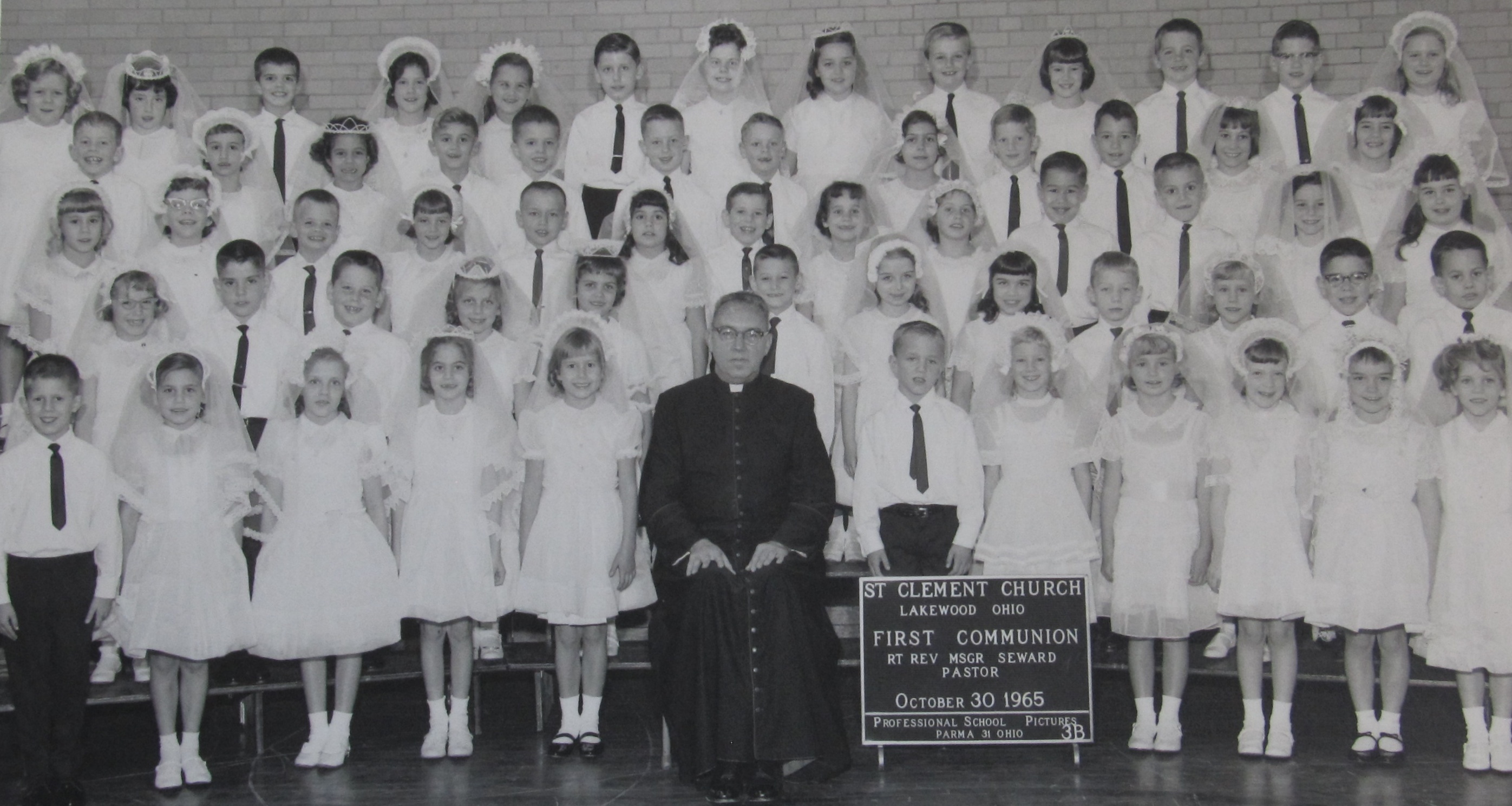
The Jesuit saying, “Give me a child until he is seven, and I will give you the man,” is apropos for my acquaintance with the first artist, Jerome Caja, the notorious bad boy of the San Francisco gay art scene in the late 1980s to mid-1990s. In September 1964 we were both pupils in Mrs. Kosowski’s dreadfully-overcrowded (45 pupils, 42 desks), Irish-, Czech-, Polish- and German-American, first-grade class at St. Clements (Catholic) School in Lakewood, Ohio.

In those days, the only way the overstretched teachers could keep track of their pupils was by strict, alphabetical seating. As a result I spent most of my time in elementary, middle and high school talking, working and socializing with pupils towards the middle of the alphabet such as Larry McMurtry, Megan Rowe, and Jerilyn Friedman. There was, however, a tall, thin boy at the beginning of the alphabet with short blond hair and glasses so thick they left red dents on his nose, (on the rare occasions he removed them), who caught my attention. Not only did he look interesting, but he was also good at storytelling and mimicking the mannerisms of some of the students and teachers out on the playground during recess. With these skills, he soon made himself known in the large class and had attracted a small group of friends (one of whom was myself).

St. Clements First Communion 1964. Bryan Monte, second row to the right of the priest, Jerome Caja, second last row, fourth from the right side.

St. Clements First Communion 1964. Bryan Monte, second row to the right of the priest, Jerome Caja, second last row, fourth from the right side.

There were other reasons, though, why Jerry was interesting and even unique. He came from one of the most well-known and devout families in a parish with ten and later eleven boys. His parents frequently attended mass, (daily during Lent), and were always involved in pancake breakfast fundraisers or ferrying boys to campouts for the school’s scout troops. (In contrast, I can remember my father taking our family home early from a parish barbeque because the man taking the tickets remarked: “Who the hell are the Montes?” even though, as he later roared in the car, “I have three kids on the God damn honour roll and nobody knows who we are!”)

In addition, Jerry lived just down the street from St. Clements, on Lincoln Avenue. I can remember going over to his house and meeting his other older and younger brothers who were almost carbon copies of each other. They all had the same tall, thin bodies, long noses, and dark Bambi eyes. The only difference was their ages. Jerry and I usually played with the dozens of green, plastic toy soldiers in the basement, lining them up for battle. That was, until one of his older or slightly younger brothers decided they wanted to wrestle. I soon learned to stay back and not join in because wrestling, for the Caja boys, was serious business. Board games and pieces flew into the air and chairs, lamps and tables were overturned as the boys tested each other’s strength. I imagine with eleven male siblings around the dinner table and two or three to a bedroom, there was probably plenty of competition for just about everything.

And there was yet another reason I felt attracted to Jerry, though I couldn’t really understand it at that time. Even though most think that a child has little knowledge of sexual orientation, when I was six going on seven I thought I had scanned some sort of understanding in Jerry’s head which comprehended why I didn’t enjoy torturing insects or small animals in my backyard or why I wasn’t repulsed by girls but enjoyed playing with them as much as with boys.

At any rate, I learned a lot that first year. I learned how to read. I taught my younger sister the phonics lesson I learned each day. Until my parents found out about my tutoring, they and my sister’s kindergarten teacher thought she was a genius. I learned how to pray. The nuns taught us the Our Father, Hail Mary and Nicene Creed in preparation for our First Communion the following year. I learned how to attend mass in the dark, stained-glass-windowed, parish church. Its clerestory walls had a mural of the saints’ gruesome martyrdoms—St. Clement, the parish’s patron, thrown off a ship with an anchor around his neck, St. Peter, crucified upside down, St. Lawrence, grilled over a fire, St. Sebastian, shot full of arrows, Saint Hippolytus, pulled apart by horses, and St. Lucy (patron of the blind and poorly-sighted), her eyes gouged out because a pagan man found them so beautiful he wanted to marry her. All these saints looked away from their torment with big, ecstatic doe eyes upwards towards heaven. From the nuns I also learned how to “turn the other cheek” when they struck me with a hand or ruler for disobeying or just because they were upset.

But with Jerry I always felt safe and by the end of the first year I felt I could ask or tell him anything. That was until our first cub scout campout together that summer. One night, Jerry and I lay next to each other on the floor of the tent in separate sleeping bags listening to the scoutmasters’ card playing and the whoosh of the Coleman gas lamp under the shelter ten or fifteen yards away. We talked for a while and when the others had fallen asleep, I asked Jerry if he would hold my hand. To my surprise, Jerry wouldn’t do this. I asked again, but Jerry continued to refuse. After repeated requests, however, Jerry reluctantly did as I asked, probably to keep me quiet. About 15 minutes later, however, he took his hand away.

The next day, everything changed. Freaked out by my hand-holding request, Jerry told all the other boys what I had asked and I suddenly found myself an outcast from Jerry and the rest of the troop who did their best to torment and/or exclude me from activities without the adult leaders knowing what was going on.

After I came home from the campout, I didn’t see Jerry for the rest of the summer and I didn’t go over to his house, afraid I’d be humiliated again. When school began in September, my distress was compounded when I discovered that Jerry and I were now in different second-grade classrooms—I in Miss Barbara’s class and Jerry in Mrs. Savage’s across the hall. Worse yet, Jerry refused to talk to me out in the schoolyard and wouldn’t let me come over to his house. He also made fun of me, throwing a limp wrist to mimic me (though I’d never done that myself) as I now became a part of his entertainment.

In my distress, I enlisted the aid of Mrs. Savage. I told her about how close Jerry and I had once been and how he now didn’t want anything to do with me. (I left out the handholding incident). I begged her to bring Jerry and me together so we could talk. One afternoon during recess, Mrs. Savage did as I requested and Jerry marched sullenly up to me in the playground under Mrs. Savage’s watchful, but somewhat distant eye. I told Jerry that I missed him and didn’t understand why he no longer wanted to be friends.

Jerry however, would have none of it. He called me “a fag” and said: “From now on, I’m only going to hang out with the cool people.” I didn’t realize our school had cool people being only in second-grade, but obviously Jerry did. I now wonder: could Jerry’s desire for fame or notoriety have been so acute, even at the age of seven, that he knew to get rid of anyone perceived as a liability?

Jerry’s desire to ignore or exclude me was difficult to maintain since we attended the same weekly school, scout and church activities together. It was torture sitting across from Jerry in the back of one of the fathers’ or mothers’ station wagons as we were being ferried to another weekend or summer campout. The connection between the Cajas and my family was also close. I can remember Mrs. Caja bringing a Ziggy cartoon book from my mother for me on the mid-week parents visit for scout summer camp at Camp Avery because my mother couldn’t leave my father’s side that evening at the family-run pharmacy. My request for Jerry’s hand was an open secret and none of the boys would share a tent with me unless the scoutmaster forced them. As Jerry led another group of boy’s on a hike into the woods to smoke, look at his older brothers’ porn or light an illegal fire, I’d lay on the grass next to my tent, reading a science-fiction novel about people travelling in a space ship at almost the speed of light, practicing my telekinesis, pushing clouds through the afternoon sky.

Jerry still found ways to punish me for hanging around. After shouting obscenities into the thick backstage curtains, upset because he was about to go on as the Virgin Mary in the nativity play, Jerry, at the last minute, stuffed me into his white sheet costume and pushed me out onto the stage. It was a non-speaking part so I kept my head down in the dim lights, hoping no one would notice me. Later that evening at home, however, my mother mentioned to my father what the man sitting next to her in the audience had asked: “Where did they get a girl to play Mary?” It was only time I can remember my father laughing uncontrollably—and not because something was funny. I began to understand what Jerry feared about my desire to get close to him, about being a fag and gender bending.

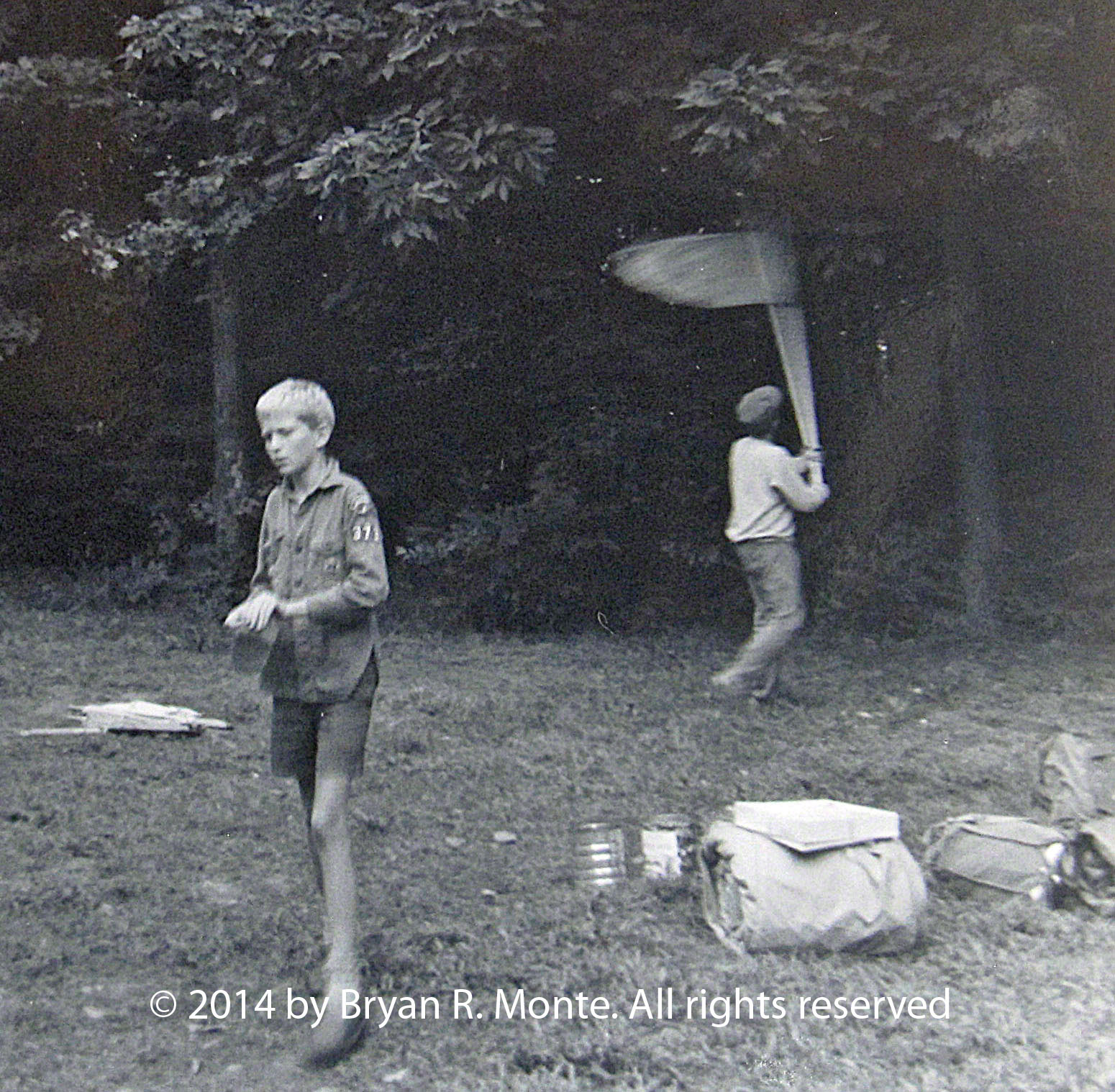
Another time, he set the cub scout pack on me literally. One winter, we were gathered inside a warm, wooden cabin in Beldwin Village in Lorain County because it was too cold and rainy outside to camp out in tents. Cooped up in this cabin, I made the mistake of looking at Jerry across the room too many times. Jerry had the boys hold me down while they and punched and pinched my bare torso so long that it burned a bright pinkish red called a pink belly. I was amazed that Jerry could be so cruel. He just looked at me and said: “You had it coming. I warned you not to look at me.” Perhaps this was the reason that my photos of Jerry at scout camp are always a bit fuzzy, taken with a simple Brownie camera and usually from quite a distance.

aq9_memoirs_jerry_sqsharp_webfoto

Jerome Caja and unidentified camper, Camp Beaumont, Ohio, August 1969. Photo © 2014 by Bryan R. Monte. All rights reserved

Serving mass together was also torture. As the two of us put on our black cassocks and white surpluses alone in the same room next to the altar, I began to feel like one of those clerestory saints being hacked or burned to bits in some sort of simultaneous earthly torture and holy communion. (This is perhaps the archetype of all my future relations with tall, blond, athletic men who I pursued or rather observed mostly from a distance after Jerome’s rejection and my social humiliation/isolation. Those blond, mostly straight men to whom I was undoubtedly attracted later in high school, but to whom I almost never expressed my need for intimacy as I had with Jerry). I also noticed that the priests seemed to like Jerry and paid him more attention even though he cursed when he tripped in his cassock going up or down the marble steps, he didn’t know all the prayers and he sometimes drank the leftover, consecrated wine instead of pouring it down the drain.

The last time I remember spending time with Jerry was in the church basement for a scout meeting. I was 12 and had made it to Star Scout with merit badges in marksmanship, cooking, coin and stamp collecting or philately (which brought lisps of appreciation from the guys in the troop) camping and hiking. I’d also recently been inducted into the Order of the Arrow after a 2-day hike and sleeping out alone without a campfire or flashlight under the stars at Beaumont Scout Camp in the woods of Northeast Ohio. I had hoped to make Eagle before I started high school, but I soon realized that wasn’t possible. Even though I was still in the scout troop, I had once again done the unthinkable and was about to leave St. Clements’ for the evils of public school. I explained to nun after nun and priest after priest who pulled me out of class and into the hallway that spring before I left, (some of whom graphically described my soul burning in hell), that my departure was due to financial considerations— the tuition having recently been increased from hundreds to thousands of dollars per student per year, a price my father wouldn’t or couldn’t pay.

At this last scout meeting in June 1970, someone had left a long, thick rubber hose on the floor of the church hall. Jerry got it into his head to tie the hose between two supporting posts to use it as a slingshot to launch himself into the air and across the hall. Instead of making him airborne, however, the cord spun and flipped Jerry over, smashing his head against the floor. Everyone was horrified by what happened, even the assistant scoutmaster, who was present. Jerry fortunately remained conscious and rubbed his short, blond-haired head repeating: “Fuck” or “Shit, that hurt,” over and over again. I don’t know if he sustained any injuries as a result or whether he was taken to hospital. That was before the days of MRI scans.

For twelve years I didn’t hear anything about Jerry. Then in autumn 1982 while attending Berkeley, my mother sent a half-page clipping from one of Cleveland’s daily newspapers. Almost as large as the article was a photo of Jerry as a seminarian with shoulder-length, blond hair surrounded by a group of adoring, but troubled, inner-city youth. It didn’t surprise me that Jerry had decided to go into the priesthood. Growing up in such a large, devote Catholic family, the law of averages predicted that at least one and maybe two Caja boys would receive a “calling.” And, becoming a priest would give Jerry the opportunity to be in front of people again in the spotlight at least once a week. Looking at Jerry’s wavy, androgynous, shoulder-length hair, though, I wondered if the Catholic Church had become more liberal or just desperate for new priests. Surely that hair made Jerry looked unmistakably gay. I wondered if he had ruffled a few feathers at seminary. A year later I graduated from Berkeley and in 1984 I got a scholarship to Brown (probably because of No Apologies, my gay literary magazine, I had founded in San Francisco the year before and continued publishing at Brown).

The next time I read about Jerry was in late 1989, two years after returning to San Francisco after graduating from Brown and teaching high school writing courses in New England. By day I worked as a microcomputer technician making rate charts and data back ups at an insurance company. By night and in the weekends, I covered the gay news as a radio reporter on a show on KPFA-FM in Berkeley. While preparing my script one night after work, I saw a photograph of a drag queen with stringy blond hair, big, Bozo eyes, and double rows of light and dark lipstick on the front page of one of San Francisco’s gay newspapers. It accompanied a feature story about a man named Jerome who had become the mistress of Wednesday jockstrap Jell-O wrestling at Club Chaos just around the corner from where I lived on Valencia Street. The photo piqued my interest because there was something familiar about those big eyes and long nose. I realized Jerome was Jerry when he identified himself as a “recovering Catholic” who had sex with men in Cleveland’s Edgewater Park.

Through my press contacts, I discovered that in between seminary and his refereeing of the Jell-O wrestling, Jerry had come to San Francisco in the mid-80s to get his Masters degree at the Institute of Art. For his graduation he had worn a transparent gown he’d made of plastic pouches filled with different coloured liquids and floating, fake goldfish. (Reportedly, Jerry was also naked underneath the see-through gown, but I have yet to see a photo which confirms this).

Even though the gay community was my beat, I had missed Jerome’s splash on the gay drag/art/sex/literary scene, probably because when he was at Club Chaos, I was in bed as I had to go to work the next morning. And it was still a few more months before I literally ran into Jerry by accident, one cold, windy, January night walking up Castro Street. All 6’7” of him, hard skin and bone, literally collided with me in front of the Castro Theater. He was wearing his trademark high heels and fishnet stockings. I also could smell beer on his breath and figured he was drunk. I said: “Jerry, it’s me, Bryan.” Jerry just stared at me and said: “That’s great, baby, (burp), but I got to go,” and he continued walking down Castro Street. I don’t know if he recognized me. I would have liked to have invited him for a cup of coffee at the 24 hour donut shop down the street, but once again, he didn’t want to talk.

A month later, I heard about Electric City, a weekly LGBT TV show broadcast on San Francisco City College’s cable channel. Electric City had heard about me too. They suggested I do the gay news for them. From the beginning I was a bit apprehensive. This rag tag group of druggy, leather and drag queens was a little too over the top for me. In addition, I believed radio was a much more intellectual medium. What you said on the radio was more important than how you looked or what you did while you were saying it. Against my better judgment, I consented to a tryout. As I had expected, I spent hours in makeup or in front of a camera doing many takes for the same news segment I could have delivered live, unshaven and shabbily dressed on the radio in 10 minutes. I soldiered on, however.

As I was taping one day, Jerome walked in the door. I had heard Jerry was part of group, but I hadn’t seen him since I’d bumped into him in front of the Castro Theatre. Jerry said hello then went into a back room to get ready for a short promotional segment. They filmed Jerry lying flat on an ironing board and, by some sort of trick photography, blotted out the board and made it appear as if he was flying through the air. That day or a week or so later the crew asked me to stretch out my arms over my head and jump up and down. Then, they adapted this video to make it seem like I was jumping while holding the Electric City logo.

At the beginning of April, Jerome had a big art show in a space (a former shop) at Collingwood and 19th Street then called the Art Lick Gallery. The name of the show was “Compact” and I remember trying to look through the white sheets taped over the windows while Jerry hung his very small, framed miniatures painted with nail polish on “found” materials (such as used McDonald’s French fry cardboard holders, junk mail envelopes, plastic restaurant tip trays, recycled paper or tin foil). Some, due to the erotic subjects like “One, Two, Three, Pee on Me, nail polish on tin or “The Foot of Christ,” enamel on toenails (1991), reminded me a Roman art work or early Christian reliquaries. “The Birth of Venus in Cleveland,” nail polish on plastic tip tray (1988) is a self-portrait of Jerome wearing only fishnet stockings and a bra, standing in an inflatable children’s wading pool in a backyard. In the background is a clothesline on which laundry dries, the line attached at one end to a column atop which is a statue of the blue-robed Virgin Mary. This scene, (except for Jerome’s nudity and transvestitism), was familiar to most Catholic families in the Lakewood whose large families (four child minimum on my street) played in backyards that included hand-made shrines to the Virgin made from upturned white washtubs with a statue on a pedestal in the middle. And Jerry’s Marcel Duchamp/Salvador Daliesque (re)interpretation of Bartolome Estaban Murillo’s “The Immaculate Conception” by painting Bozo clown faces on the Virgin and the angels surrounding her in the clouds, placed Jerry’s painting solidly in the Postmodern movement since his unique sign(ature) over Murillo’s work hijacked and upended its motif and critiqued Catholic tradition.

Although I’d been on the radio for a while, very few of my friends and none of my co-workers had noticed or even commented on the show. Once the Electric City promos were broadcast, however, friends, co-workers, even strangers in the subway stopped me to ask me if I was that guy on TV. I realized then the power of TV over radio. I also realized I might be able to make a name for myself and maybe some real money. My natural cautiousness and the desire to stay out of the spotlight, however, kept me from pursuing it. I decided that even with TV’s increased recognition I was going to stay with radio. Then I invited the cast of Electric City to be interviewed by me on the radio in May or June 1990. The night of the interview, however, no one showed up. Through Rink, a photographer friend, I heard they’d got their dates mixed up (even though it was in the station’s published calendar) and were sorry about it. Due to a conflict with my fellow program members shortly thereafter, however, I decided to leave the show and the station, so I never got another chance to interview Jerry or Electric City on the radio.

I did see Jerry, however, one last time, just a few days later, at the head of the 1990 LGBT parade even though I didn’t recognize him. Wearing a Hare Krishna orange-coloured outfit including a skull cap, (which completely hid his long hair), big round glasses, a round gold disk hanging from one ear and a bagel from the other, an orange sash, leopard lingerie and a Kielbasa sausage hanging from a chain link necklace, Jerry created a new persona: Konnie Krishna. As he walked the parade route, people around me asked: “Who is that stealing the show?” and I couldn’t answer them.

A few weeks later, while resigning from the radio show and handing in my keys at the station, I saw Jerome’s name with Steve Abbott’s and a few other San Francisco writers I’d published in No Apologies. They were involved in a big reading in San Francisco, but somehow had forgot or neglected to invite me either as a writer or a reporter. I felt betrayed and excluded once again. I stopped writing gay news stories in my spare time and started teaching ESL and creative and technical writing evenings after work to save money to leave town. Since my insurance company had already been through three reorganizations going from 17 to 12 to 7 offices nationwide, I figured I wouldn’t survive the next one. In addition, even though I’d been looking for another job for the last year and half, I hadn’t had one offer since most businesses downtown were downsizing and/or moving out of town.

Moreover, almost a dozen friends had sickened and/or died of AIDS related illnesses including two ex-partners. San Francisco was turning into a ghost town. I started imagining seeing people on the street that I’d known years ago, who I later discovered were (long) dead. I also thought that even though I had tried to be “careful,” I probably didn’t have much time, so I figured I had the opportunity for one last adventure.

In 1993, I moved to the Netherlands with a one-year job contract and a journalist quality camera. I lived in two small rooms in a barely heated attic for two winters. By spring 1995, I had my own apartment, lived a Spartan life and, through some 16-hour workdays, created a slightly profitable computing and English teaching consultancy. Later that summer, I suddenly and inexplicably felt moved to start writing a long poem about Jerry, which I worked on for months in between projects. On the phone in early November just after my birthday, I mentioned the poem to a friend in San Francisco. He paused, then choosing his words carefully, told me that after a long illness, including the loss of his eyesight due to CMV, Jerome had just passed away of AIDS-related illnesses. (I discovered later he’d died on my birthday). The synchronicity of wanting to write a poem about him in the last months of his fatal illness and the date of Jerry’s passing wasn’t lost on me. I wondered if somehow Jerry, in his distress, was somehow able to contact me as my parents had before they passed—sending their fatal heart attack and stroke pains to me thousands of miles away so I packed my things at work or made plane reservations at home even before the phone rang.

After that, I spent the next few years running my business, securing my permanent residence permit, and developing my first serious, long-term relationship (at the age of 41!). I went from teaching courses at a private college to getting a job and tenure at a public one. During this time, I lost track of Jerry’s artwork and its legacy. On one of my yearly visits to San Francisco, though, poet Ed Mycue, mentioned that there was a book about Jerry on sale at bookstore at 20th and Valencia, once again, right around the corner from where I had lived in San Francisco.

On a table next to the window I found a prominent, fanned stack of large, orange-coloured, hardback books: Jerome: After the Pageant, by Thomas Avena and Adam Klein. On the cover behind his painting of the Bozo clown-faced angels and the Virgin, was a Jerry himself with big glasses and lips. Inside I discovered various photos of Jerry with which I wasn’t familiar. The most interesting was a photograph of Jerry’s paternal grandfather and his brother-in-law dressed in women’s clothing and his paternal grandmother and her sister dressed in men’s. There was also a very uncharacteristic painting, “Still Life with Broken Doll,” (1988), interesting for its distortion in perspective. The traditional bowl of fruit and vase flowers on a red table cloth tilted perilously downwards as if they were about to fall off. A doll with its right arm broken off was also splayed across the tabletop. The room also has a yellow chair and walls of deep blue. Outside, beyond on the orange curtains and pumpkin on the windowsill, is a white picket fence and another house painted in Van Gogh-like thick, eerie strokes as if a strong wind or a tornado, were about to blow it apart.

As a result of knowing Jerry since he was in elementary school and his family’s contact with mine, I think I have a very good understanding of how his Catholic background, which persecuted him for being gay, “inspired” paintings such as “Sacred Heart Circle Jerk,” “Rape of the Altar Boy,” and “The Last Hand Job.” His “The Holy Spirit Getting New Eyes for Saint Lucy,” painted in 1988 seems particularly prophetic as Jerry lost his eyesight months before he died. I wonder if in heaven, God, in his Infinite Mercy, restored Jerry’s vision, as he did St. Lucy’s, her eyes found miraculously intact in her corpse just before her burial, usually portrayed as being brought back to her on a golden plate in the beak of the dove of the Holy Spirit. For those of us left behind, I only hope we can learn to see as well as Jerry did and to make something beautiful and unique from our lives no matter how long or short they prove to be, no matter how rich or poor we are, no matter who includes or excludes us.