Bryan R. Monte – (AQ14) Autumn 2015 Museum Review

Zero—Let Us Explore The Stars Exhibition, Amsterdam Stedelijk Museum   7 July to 8 November 2015
by Bryan R. Monte

If you are in Amsterdam on a rainy afternoon and the lines at the Van Gogh Museum and the Rijksmuseum both wind down the street, may I suggest a visit to the Amsterdam Stedelijk Museum’s, Zero— Let Us Explore The Stars special exhibition. Even though I thought I was fairly well versed in “Modern” art, I was surprised last July to attend the press opening for a retrospective of an art movement about which I had no previous knowledge.

Zero is an exhibition about a group of optimistic, future-oriented, European (Dutch, French, German, Italian and Swiss) artists, who, in the 1950s and early ’60s, used simple, cheap, monochromatic and sometimes recycled materials in novel ways including puncturing, (Henk Peters), cutting and burning, (Otto Piene), mounting or stacking (Amando and Jan Henderiske) or just painting and/or displaying found objects (Jan Schoonhoven).

Zero artists (or spouses) with the Zero Manifesto on wall behind them at the Amsterdam Stedelijk Museum, (4 July 2015). Back row l. to r.: Elizabeth Goldring Piene, Christian Megert, Jan Henderikse and unidentified woman. Front row l. to r.: unidentified man, herman de vries and Uli Pohl.

Zero artists (or spouses) with the Zero Manifesto on wall behind them at the Amsterdam Stedelijk Museum, (4 July 2015). Back row l. to r.: Elizabeth Goldring Piene, Christian Megert, Jan Henderikse and unidentified woman. Front row l. to r.: unidentified man, herman de vries and Uli Pohl.

Just as with any new movement when people are experimenting with materials, some were more successful than others. Henk Peter’s Aquarel (1966, 2014 reconstruction), a wall of water-filled, triangular-shaped plastic bags filled and hung against a black background and illuminated by spotlights was for me the simplest yet most memorable work in the exhibition. The 20 rows of perfectly aligned bags of water catch the light in such a way that they actually shine against the black wall. Followed closely thereafter would be Yoyao Kusama’s One Thousand Boat Show (1963) a boat made of what looks like white stones, with hundreds of identical smaller images of the same boat projected around it, which seems to float in the room. And a third work would be Jan Schoonhoven’s R 62-16 (1962) mentioned above which, once painted white and mounted, shows the simplicity and the restful rhythm of its repeated structure.

Less successful in my opinion, however, are Amando’s tires mounted on a wall, Guenther Uecker’s chairs or TV sets with nails pounded in their sides or Jan Henderiske’s beer crate or cork sculptures, which although most students are accustomed to stacking crates in their rooms to make cheap shelving, I wouldn’t particularly call that art. In the same vein, herman de vries’ white, seemingly architectural, model building blocks don’t move me as much as Otto Pien’s perforated metal drum with its rotating internal light source that casts changing, expanding and deflating geometric images on the surrounding walls. Similarly the optical illusions that would come later in the sixties are preceded by works such as François Morellet’s, Sphère-trames, stainless-steel sculpture (1962) or the more dynamic optical illusions (albeit monochromatic ones) created by Günther Uecker’s, Heinz Mack’s and Otto Peine’s Lightroom gallery: Homage to Fontana (1964).

Some of Zero’s real treasures, however, are reserved for almost last. Two galleries to the left of the entrance hall (the last two if you follow the map provided by the museum) is a room of Zero videos. The best of these are the nude body painting performance art of Yves Klein with a live, seated audience and string quartet accompaniment in addition to Heinz Mack’s silver spaceman clothing, tall poles hung with round and banner-like silver reflecting material which seems set on another planet rather than on a North Sea beach. The former clearly seems to pre-date the later sexually-free counter-culture happenings that would take over campuses and the art world just a few years later.

Even if its sunny outside, I’d still recommend you take a break from the crowds on the Museumplein and use the opportunity to learn more about a relatively unknown (for me) 1950s and early ’60s European art movement which was the historical predecessor of the optically illusionary and happenings art of later ‘60s and early ‘70s. I guarantee your time at the Stedelijk will be well spent.

Bryan R. Monte – (AQ14) Autumn 2015 Book Reviews

AQ14 Autumn 2015 Book Reviews
by Bryan R. Monte

Nights at Rizzoli by Felice Picano. O/R Books, ISBN 978-1-939293-67-1, 224 pages.
The Don’t Touch Garden by Kate Foley. Arachne Press. ISBN 978-1-909208-19-3, 61 pages.
The Magic Laundry by Jacob M. Appel. Snake Nation Press, ISBN 978-0-9883029-9-0, 134 pages.
When I was a Twin by Michael Klein, Sibling Rivalry Press, ISBN 978-1-937420-91-8, 63 pages

My mailbag was much heavier this summer due to readers’ responses to my short, diaried memoir of Philip Levine and the books I received from publishers and authors. I have had plenty to read and I have selected one memoir, one book of short stories and two books of poetry to review for a good mix of genres.

The memoir, Nights at Rizzoli by former New Yorker and now Southern California resident, Felice Picano, is a small, handsome book with beautiful cover art—NYC building fronts (front) and artists, (back) by Max Wittert. It describes Picano’s work at the Rizzoli bookstore in “snotty, pushy, Upper Midtown Fifth Avenue” (across from Tiffany’s) in the 1970s, the store’s multi-national, polyglot staff and their celebrity customers. These included among others Mick Jagger, Philip Johnson, Salvador Dali, Rose Kennedy and Jacqueline Kennedy Onassis. Picano presents most of these encounters with celebrities as things that just happened to him, not meetings he sought since he fails to recognize both Kennedys until well into their first meetings and, in fact, he turns down a date with Johnson at his “nine-room penthouse suite overlooking the city.” Then there are the more unusual encounters such as the man who was building a new house in Montana who asked Picano one evening for suggestions on what sorts of books he should stock there to make his artist guests feel at home. Seven thousand dollars worth of books later, Picano helped him find an answer.

At his job interview, Picano is asked to make suggestions on how the store can improve its sales—“get more intellectuals and college students coming in…by offering Garcia Marquez, Octavio Paz, Lezema Lima.” Rizzoli continues to expand as Felice convinces the store manager, Mr. M., to display English-language, best-seller books in the store more prominently, especially Jaws for which Picano makes a special poster composed of “a pair of snorkel goggles I owned, splashed…with nail polish and added in my old rubber swim fins…chewed up with a box cutter.” Picano also assists in setting up Rizzoli’s art gallery next door whose opening features Erté’s work and includes the appearance of the legendary dancer, Josephine Baker, who arrives in a white Rolls Royce.

In addition to his bookstore duties, Picano also describes his activities as a nascent gay activist, as the leader of the Purple Quill gay men’s writers group and as a volunteer in an ad hoc vigilante squad through which on “Thursday(s)” from “midnight to 3 A.M.” he protected the gays and their suburban daddies who had sex in the empty meat and produce trucks parked “beneath what was left of the elevated West Side Highway” from teenage gangs from “the projects above 14th St.” Picano’s partner in this squad was an Afro-American transexual called Marsha Johnson who “kept three sharpened-to-stiletto-point Afro combs in her big “do.”” Picano’s memoir takes you close to the action—physical, historical and sexual. His writing style is very clean and his description has just the right number of details to place his reader firmly in the milieu making his memoir not only informative, but also entertaining.

The second book is The Magic Laundry by Jacob M. Appel. This collection represents his third prize for fiction writing in about a year. Winner of the Serena McDonald Kennedy Fiction Award, The Magic Laundry is a collection of eight interesting and quirky short stories. By accident, I was sent a few extra copies. Appel wrote that I could keep the copies for myself. I wrote him, however, that I would give them to my workshop students with the adage: “This is how you write good short stories!”—and that’s true. These stories are composed of characters from many walks of life all dealing with life’s unexpected twists and turns—from within or without—a university professor and Darwin descendant, whose daughter returns home at X-mas break with an orang-utan she liberated from her university’s animal laboratory, a Turkish watchmaker in Brooklyn who decides to join the fight against the construction of a sports facility in his neighbourhood because leading the charge is a very attractive woman only to discover, accidentally, that he has a talent for public-speaking and politics, and the cover story about a man who wants a nice, quiet job so he can study the classics and play baseball, whose parents set him up in the coin laundry business whose machines mysteriously seem to heal people’s ailments, creating problems with his customers and competitors. This collection marks the post-Modernist end of the Hemingway code where heterosexual men avoid “talky time.” Appel’s main characters are well-rounded, articulate (at least internally) and caught in multi-tiered conflicts, whose outcomes this reader usually found (seven out of eight times) delightfully unexpected. If you want to know more about how to write contemporary fiction, read this book.

Even though the old adage goes: “Never judge a book by its cover” the cover of Michael Klein’s new poetry book, When I Was A Twin, is certainly very attractive. Looking like “Wolverine goes to Fire Island,” Klein stands tall on the front cover with his brushed back hair and beard and big hands, wearing a P-coat on a wooden boardwalk which winds out towards the ocean. This is another exquisite cover from Sibling Rivalry Press—cover photos and art by Shef Reynolds; cover design by Seth Pennington.

The poem “Harmonium” begins this collection. It’s a haunting update about what has changed in the poet’s world and life (with a reference to Allen Ginsberg’s trademark harmonium playing at his readings) since the death of the person to whom it is addressed. The poet mentions Bruce/Caitlan Jenner’s transition, gay marriage, not going to cinemas anymore to watch films and: “Websites: So many websites like radium./There’s a website that consists entirely of lists/Whenever I look at a list with names on it/I think of death and awards.” With this poem, Klein deftly introduces the three subjects—death and lists and fame—which his book explores throughout.

His structural alternation of block prose poems with more experimental list poems, whose imagistic links change sometimes from line to line, and his use of these two forms to explore subjects such as film, theatre, actors, actresses, and horse racing, caught and kept my interest through the entire book. And the list poems with their fast changing-linking-build-your-own-narrative, rather than covering up or confusing the subjects actually strips away and clarifies them. Klein, like Trinidad in this issue, also has a poem about 9/11, “The planes I said and then the nothing afterwards,” which describes the cruel chance that determined who survived that day: “Did they ask for more/living at the intersection of alive and not living?” and the bewilderment of those survivors who lived to see the disaster wrought by Hurricane Sandy a few years later: “And now, or just last week, more disaster: the predicted water/took up something furious to wreck the houses down in Queens.”

But it is the sorrow for a sibling slowly drowning in depression at a distance which is the main theme of this book, an experience rendered painfully accurate in “The Motivation of an Actor”

….I watched my brother live, but couldn’t touch the flame around his life. And I didn’t want to be absorbed by art. I didn’t trust art to throw me back….

Klein’s poetic rendering of his relationship with his twin brother rings, unfortunately, very true to my own with a schizophrenic, artistic relative.

And I do have another confession to make. Even though I’m gay, I must admit I have more of an affinity for Klein’s poems about horses “Other Horses” (experimental poem) and “The Lives of Horses” (prose poem) than for those about the theatre and film, “Music for the Theater” and “Giuliette Masina” having gone yearly to watch a cousin compete in the equestrian arena at the state fair. I do still, however, enjoy Klein’s list poems such as “Things that Might Be True” and “The Medium” having also started to write my own series about past boyfriends and therapists and why things went wrong.

When I was a Twin is a book of well-written poems, some more challenging and experimental than others. (which, in my opinion, is exactly what a poetry book should offer). I think readers will experience much leesplezier (reading pleasure) as we say in Dutch from this thin volume of poetry, which I wholeheartedly recommend.

Last is a poetry book by British-born, Amsterdam resident and local treasure, Kate Foley. The Don’t Touch Garden is a compilation of poems from six of Foley’s previous books. These poems are about birth, adoption, childhood, family and and the search, albeit too late, for one’s biological parent. This new edition of these poems by Arachine Press is bound in a cover which includes a photo of a garden with a gate and a bench which, despite the book’s title, seems to welcome one in. This book, like Klein’s, is small enough to fit into a coat pocket and is the type of book I would read and meditate on when I was younger as I wandered around my town “looking for the trapdoor out of suburbia.” In “Bison” Foley comments on her almost lifelong lack of knowledge of her biological parents: “My pre-history is as blank as a people without pots/or bones.” Or with advancing age, suddenly finding our parents in the mirror as we begin to resemble them unwittingly physically and psychologically. The poem “Paradox” also discusses this voyage of discovery of parentage: “Mirror, mirror on the wall/the old joke goes/I am my mother after all.//but which ?” It also illustrates her advice in the introduction to this volume: “to parent the face we find in the mirror.” It is a brave book, which recreates what some children growing up were probably told to (and would like to forget), but which others feel impelled to explore to understand who they really are.

The Don’t Touch Garden includes poems about war-time Britain, (the title poem being the longest and the most interesting in this collection to me due to its historical nature), poems about young parents, “Corchipoo,” (including a young child overhearing her parents having sex) and an abusive, adoptive uncle “The Man on the Bike.” In this poem, the adoptive mother asks: “Tell me! What did he say?”//She means ‘What did he do?’” The tensions between wondering about who her birth parents were, to trying to find a place in a home where she doesn’t seem to fit due to her expanding poetic perception and her parents’ more restricted worldview (whom she takes care of as they age) continues throughout the book including the poem, “The End of a Long Conversation” where Foley meditates on her parents’ death and final separation without a proper good-bye. The Don’t Touch Garden is small, beautiful, thought-provoking book, which should be in every English-language collection about adoption and searching for one’s true parentage.

Joan Z. Shore – The Media: Then and Now

The Media: Then and Now
by Joan Z. Shore

I was lucky enough to be working in the media—radio and television—during the glory days, right up to the end.

Personally, I place the end shortly before the year 2000, just before the Internet took over our lives.

For nearly a decade, I was the Paris correspondent for CBS News, lurching from press conference to press conference, from calamity to calamity, along with my colleagues from ABC, NBC, and later, CNN. We were just a handful among 3,000 accredited foreign journalists in Paris—writing, recording, filming, editing whatever we thought would be important, or interesting, to our unseen audience “back home.”

In America, as in in most countries, foreign news does not take priority over local events. So while radio needed endless material for the hourly reports, television was only interested in foreign news when something really big happened: a presidential election, a terrorist attack, an airline accident. We didn’t have to wish for those: inevitably, they happened.

One of the more delightful events that absolutely had to be covered was the inaugural flight of the Concorde: Paris to New York in three and a half hours! To cover this momentous occasion, CBS sent over their venerable newsman, Walter Cronkite. He spent a couple of days in Paris before the flight. It was the first time we’d met, and we quickly established a friendship. One afternoon, we were sitting at an outdoor café on the Champs-Elysées, and at least half a dozen American tourists spotted him and came over to say hello.

“You see?” laughed Walter. “They recognized you!”

Hardly.

When the day came for the Concorde flight, I accompanied him to the airport, and we joked about sneaking me on board. No way.

We met again when he visited Paris with Betsy, his beloved wife, and we had dinner together at a simple restaurant in my neighborhood. The French clientele didn’t pay much attention, but the owner recognized him and asked him to sign the guest book. Graciously, he did.

We met again in Nairobi. I had just been on safari, and he was doing a story on tribal medicine and witch doctors, part of a series.  He seemed fairly impressed by what he had learned. “There may be something to it,” he said. Walter never dismissed a new idea, a new concept, a new viewpoint.

We met again in Vienna, after his retirement from CBS. He was reporting for CNN on the gala New Year’s celebration and the New Year’s Day concert, as he did for many years. He looked splendid in his tuxedo, but expressed regret that he had retired from the CBS news desk “too soon.” Clearly, those cultural jaunts were fun, but too tame for this maestro.

Whenever I was in New York, we tried to get together. I remember a lovely lunch at the Russian Tea Room, where he had his special table. And a drink one afternoon at his favorite East Side bar, when he arrived limping due to a leg injury. There would be no tennis and sailing that summer.

And once, he called me and simply said, “Hello, Joan,” and I absent-mindedly said, “Who’s this?”

“Oh, my God!,” he said. “She doesn’t recognize my voice!”

“Walter!” I exclaimed, thoroughly embarrassed.  “I must be deaf!”

Walter’s voice was distinctive and rich, as were most media voices in those days. Today, the networks concentrate on appearance, not voice: the perfectly combed hair, the deftly powdered face. But even this may be a vanishing illusion, as network news shrinks in relation to the Internet.

In Paris now, there are fewer than 1,000 accredited foreign journalists. The big three American networks closed their Paris bureaus 20 years ago believing that more important things were happening elsewhere in the world, and that maintaining a fully staffed bureau anywhere was simply too expensive. So there are no more cameramen, soundmen, editors, bureau chiefs. There is, instead, a whole generation of free-lance writers and bloggers. Sometimes their reports get picked up by an Internet site; rarely will they be paid. (Arianna Huffington perfected this “fame but no fortune” principle, promising her contributors “exposure” in lieu of monetary compensation.)  So we have an army of self-appointed journalists who lack training, experience and pay; who probably have a camera in their pocket; and who can, at a moment’s notice, tell the world that there’s been an accident on Main Street or a deadly fire in a garbage dump.

Let us not blame the messenger entirely; the nature of our communications today is fast and shallow. In-depth reporting is rare, and audiences are impatient. The 30-second soundbite has been reduced to 20 seconds, and the seasoned correspondent who spent years in a foreign office—lunching with a senator, interviewing a local businessman—exists no longer.

And we are the poorer for it.

Dianne Kellogg – Fall Through the Screen

Dianne Kellogg, Fall Through the Screen, photograph, 2014

Dianne Kellogg, Fall Through the Screen, photograph, 2014

Yolanda V. Fundora – Bogart on Ocean Drive

Yolanda V. Fundora,  Bogart on Ocean Drive, digital art, 2015

Yolanda V. Fundora, Bogart on Ocean Drive, digital art, 2015

Susan Lloy – Oh…

Oh …
by Susan Lloy

Oh … the word falls from her lips as her reflection stares back. It’s as if she’s encountering herself for the very first time instead of after forty-two years of presentation. She’s invested in her trade with nips here and injections there; what little body fat she once had has been harvested and replanted in problematic areas. Thighs and abdomen sculpted. Breasts enhanced and resurrected to salute the heavens. Though today, as she inspects herself, she suddenly realizes that it’s all over.

She started as a ripe teen working as a stripper. Earning extra cash while studying anthropology at university. Gradually she thought; ‘What’s the use of a degree like this’? finding it more lucrative to strut her young bones and make a pile of money. The money was good, so good that she transitioned from stripper to escort. And although she had generous clients throughout her career, even one or two who promised to take her away from this, she likes her work and holds no wish to be dependent upon a man. There’s no denying that she’s kept her looks with the aid of costly expenditures, but if someone’s paying for sex; let’s face it, they want the fresh ones.

She’s never been good at planning and doesn’t have bundles tucked away, yet she owns a cottage in the hipster part of town with a lovely garden overflowing with crimson roses and hollyhocks. There’s enough money to last six months without worry supplemented by the odd Tom, Dick or Harry, but she can’t count on ‘johns’ anymore and must devise a plan. She’s disciplined when it comes to maintenance. For the most part she eats raw, with the exception of grilled fish or chicken for the necessary protein. She does hot yoga three times a week, swims every day and never ate gluten, even before it became fashionable. It is a boring regime, though necessary to keep her lean body, the currency of this firm.

She looks around her space and picks up her agenda. It’s without a single entry for the weeks stretching ahead. She isn’t skilled at anything other than great sexual performances. A few years back, a friend was at a crossroads and progressed from sexual contortionist to a writer of erotic literature and screenplays. This friend has done well for herself and so she picks up the phone and gives her a call.

“Hello, Vivian here.”

“Vivian, it’s Annie.”

“Oh, hi! Haven’t heard from you in some time.”

“Yeah, you know how it is. Something always comes up.”

“Speaking of up, how goes business?”

“Well, it’s practically nonexistent, which is why I’m calling. I need to pick your ear.”

“Pick away.”

“How easy, or should I say how difficult, was it for you to obtain the success of erotic bard?”

“It took some time, however, I have friends in the business and so I had an in so to speak. Why? Thinking of trying yourself?”

“I am actually.”

“Well, I can give you some contacts. Have you ever done any film porn?”

“No.”

“Listen, Thursday afternoon I’m sitting in on a closed set. Actually, it’s a script that I’ve written. Do you feel like observing?”

“That would be great!”

“OK, then. I’ll pick you up at eleven.”

When Vivian arrived she was considerably heavier than Annie recalled. It had been nearly one year since they had seen each other, as two passing ladies of the night at an expensive downtown restaurant. They had been there with their respective gentleman callers who didn’t behave like gentlemen. Annie and Vivian had caught up in the ladies room where they had both complained about their clients who drank too much, talked too loudly and ogled every woman who walked. Both made passes at the waitress who tolerated it all with the hope of good tip. Then and there they had mutually agreed, “We gotta get out of this business.”

Vivian had done some hard porn in her youth; a rising starlet in the adult film industry, but due to a car accident had to quit the camera, because the scar on her torso which was too difficult to camouflage. She had acquired a substantial fan following in her short career and some of her devotees enjoyed caressing this imperfection within the confines of her atmospheric boudoir when she flipped to private escort.

They arrived at the set where everyone made Annie feel welcome and Vivian introduced her to the director, actors and camera crew. Following the shoot, the crew and cast headed for lunch. Vivian and Annie were guided by two young Romeos, who flirted, stroked their arms, all the while discussing various parts of the script. They were led to a banquet table that was bursting with everything one could dream of tasting. Corks popped and bubbly poured as if it was the premier instead of an afternoon wrap.

As it turned out this was a celebration for two of the main characters, for this was to be their twenty-fifth production together, titled Swallow Me; about a guy who picks up a girl at a wine tasting soirée. Vivian mentioned it didn’t have much of a plot, however featured a lot of steamy love scenes, which were precisely what the viewers expect.

Vivian made a lunge towards the table and quickly piled her plate with delights. Followed by chowing down on a French Horn pastry, which oozed with cream and possessed a rather phallic semblance itself.

“What the hell,” announced Vivian. “I’m sick of starving myself for my figure.”

Annie remained controlled and sparingly arranged the raw vegetables around a piece of grilled sole, solemnly chewing on a carrot. She had to admit control, although a life choice, is often monotonous.

Following the shoot Vivian dropped off Annie and provided some contacts: names of a few directors and editors. She stressed, “Don’t think too much about it, just let your previous experiences run out, you’ll see.” Annie sat in the salon and put her feet up, which were swollen from her six-inch heels. Her reflections turned to Vivian and her newfound freedom she envied. Vivian too had once governed her body like a fierce dictator, though now her rule seemed to have exiled to parts unknown.

Overcome with an overwhelming urge for forbidden delicacies Annie surrendered to her whims ordering several take-outs: Pad Thai, deep fried chicken with gravy and fries. Banana cream pie. Abandoning the regiment she has so long adhered to.

The breeze from the open doors nudged the linen curtains and the hollyhocks danced beyond, permitting the scent of rose to circle the room. She picked up a pen jotting down working titles such as, Oversize Me, Mister Big and Dude, Don’t Stop, allowing her thoughts to perform like well-seasoned lovers and words to dominate the page.

AQ14 – Radio, TV & Film

David Trinidad – Straighforward and Candid

Straightforward and Candid
An Interview with Poet David Trinidad

by Bryan R. Monte
Copyright © 2015 by Bryan R. Monte and David Trinidad.
All rights reserved.

David Trinidad is a professor of creative writing and poetry at Columbia College in Chicago. He is the solo author of twelve books of poetry, the co-author of another four, the co-editor of the poetry anthology Saints of Hysteria, a former editor of the literary journal Court Green, and the editor of the works of poets Ann Stanford and Tim Dlugos.

Bryan R. Monte: My first question, David, is that with all your projects and duties, how do you ever find time to write?

David Trinidad: When I was younger it was quite a struggle. I never seemed to have time to write. Or if I did, the actual writing was difficult. I felt such pressure to produce. It’s not something I fret about anymore, thankfully. My teaching job and editorial/scholarly projects feed, rather than hinder, my creativity. Writing, reading, editing, teaching—they all work together.

BM: Do you consciously make time to write poetry or does it burst into your life of its own volition?

DT: It can happen both ways. I’m fairly disciplined. I like to work in the morning, for four or five hours, but not necessarily every day. Poems can happen in one sitting or stretch over many days, even weeks or months. Once a poem is in motion, it’s always there, in the back of my mind. I can’t really rest until it’s finished. Words and lines will come to me as I’m trying to sleep; I have to keep turning on the light and jotting them down. I’ll wake up the next morning with more words and lines, as if I’d been working on the poem in my sleep.

BM: How old were you when you first started to write poetry?

DT: I wrote some poems when I was child, but didn’t really start writing it seriously until I was eighteen or so.

BM: Was there a specific person who sparked you to write poetry for the first time?

DT: As an undergraduate at California State University, Northridge, I took Introduction to Literature with Ann Stanford. I had no idea she was a well-known poet. She showed us an example of found poetry. I was intrigued by the idea that you could take an existing text and make a poem out of it. She said she’d give us credit for one of our assignments if we wanted to try our hand at it. So I went home that night and opened the Los Angeles Times to an article about Marilyn Monroe’s death and formed a poem out of some of the sentences. I called it “With a Phone in Her Hand.” Ann liked it, and that gave me the courage to try other poems. I still have it; it’s the oldest poem I kept from those days. That was in 1972.

BM: When did you first know you wanted to be a poet?

DT: I never presumed that I was, or could be a poet. Or even wanted to be one. I wanted to be a writer, but assumed I would write short stories and novels. When I was twenty-one, something magical happened: I wrote my first real poem. It seized me, came through me very quickly and forcefully. I was exhilarated and astounded. Even though I’d been writing poems for a few years, this one was markedly different. I knew something significant had happened. It was like I’d been switched to a higher voltage. After that, all I wanted was to replicate that experience. I really wanted to be a poet.

BM: Who were some of your favourite poets (both dead and living) as you were learning your craft? What did you learn particularly from these poets and their works?

DT: Anne Sexton was the first poet I seriously connected with. I discovered her work in 1975, just months after her death. Her books were everywhere then. I came across Love Poems in the poetry section of the B. Dalton Books at Northridge Fashion Center. I bought it, took it home, starting reading it, and was hooked. I devoured all of her books, one right after another. Sylvia Plath was very important to me, too. She was also pretty ubiquitous at that time. Through Plath, I learned about Ted Hughes. Ann Stanford was my teacher at Northridge, so I studied her books on my own. She was friends with May Swenson, so I read her as well. Allen Ginsberg and Frank O’Hara were on my radar—I loved those City Lights pocket books. I learned a great deal from these poets. All of them had an honesty and directness that I responded to. Each created a world I could believe in and inhabit. I related to the feelings, no matter how different their experiences were from mine. They made me want to contribute something of my own, something of my self. That was key, the authentic autobiographical nature of their work.

BM: You’ve said that you studied writing with Ann Stanford at college. What did you learn from her? For example, what were one or two specific insights she gave you about your writing and the direction it could take?

DT: I think more than anything it was her clarity and her simplicity. She says what she has to say so precisely, so perfectly, with just the right words. She taught me that you don’t have to overdo it. No need to force your viewpoint or knock the reader over the head with your truth. I also learned from her example what kind of poet I wanted to be in the world. She wrote and edited and published and did readings, but without a big ego. The work was what was important. If your poems were good, you didn’t have to promote them. Publish them, yes. But let them do their work. Poems don’t require fanfare. Ann was widely published, had won numerous awards. Late in life, she told an interviewer that being widely published and winning awards was gratifying to the ego, but not helpful to the soul. That was very telling, very instructive.

BM: Name two or three of your poems from your early, formative years that you still regard highly and explain why.

DT: Of all of my early poems, “The Boy” sticks out. I feel like that’s my voice: straightforward, candid. Language not terribly dressed up. Looking back with longing. I can still read “The Peasant Girl” and “Night and Fog” without cringing. They seem like my voice too, though both are a bit in overdrive. That’s something I often do: get revved up and try to fit as much as possible into a poem. “The Boy” seems purer to me.

BM: It’s interesting that you mention these three poems, because they’re all in your first book Pavane, which I think is a good mix of classical subjects and teenage/young adult homoangst. “Night and Fog” is a great critique of ’70s gay San Francisco, especially how the South of Market scene messed up your friend. How did go from there to your poem “Meet the Supremes,” with its long list of girl groups, in Monday, Monday, your next book, a thread which has continued in your poetry to the present?

DT: There’s actually a gap of seven years between those two poems, during which there was a shift in my writing. But I’d contend that those poems are not really that different. “Night and Fog” is a kind of list, or a litany. “Meet the Supremes” is also a list, or catalog, of girl singers and groups. The former is more direct, in the handling of the deterioration of a friendship. The latter deals with my own downward spiral and alcoholism, but is less direct. All the pop songs about heartbreak are intertwined with the deeper angst of the speaker.

BM: Did moving back to L.A. from San Francisco have anything to do with this change in your writing?

DT: It did, though not immediately. I later became friends with other young poets in Los Angeles and I was exposed to the work of the New York School poets.

BM: Was there some sort of retro-hippie movement going on in L.A. at the time that inspired you to write the poems in Monday, Monday?

DT: I’d say it was more of a “youth movement.” I was hanging out with poets like Dennis Cooper and Amy Gerstler. Dennis created a lively scene at Beyond Baroque Literary Arts Center in Venice. Others in the scene included Bob Flanagan, Ed Smith, Kim Rosenfield, Jack Skelley, Michelle T. Clinton, and Benjamin Weissman. We gave readings, published books and magazines. Dennis had Little Caesar, Jack had Barney, I had Sherwood Press. Through Dennis, I met poets from other parts of the country, like Tim Dlugos in New York and Elaine Equi in Chicago. We were all in our twenties. There was a brashness about these poets and their work, an urbanity and wit, and openness to the pop culture we’d all grown up with. I found it very exciting.

BM: How do you respond to some critics who say that some of your poems list too many things? That sometimes they are only lists or synopses of TV shows or toy descriptions, such as “Monster Mash,” “The Ten Best Episodes of The Patty Duke Show,” and “Essay with Movable Parts,” which they feel don’t really make them poems?

DT: Aside from the joy of list making, I would say that in the poems you mention there were specific conceptual concerns at work. “Monster Mash,” for instance, is both a list of monster movies and a traditional rhymed sonnet. The payoff, for me, was in the juxtaposition of the two. I don’t feel I need to defend the list poem. It has a long and respectable tradition. I guess I like to play around with the form, see how far I can stretch it, what I can make lists do. Some results are more mundane than others. But some have a kind of sparkle.

BM: In Monday, Monday, you also wrote a lot of poems in narrow columns. How did you “discover” this short, poetic line set in columnar stanzas, which you’ve continued to use in your poems?

DT: Poets I admired used that form a lot—Frank O’Hara, James Schuyler, Dennis Cooper and other friends. I was drawn to it, perhaps, because it seemed less artificial than the stanzas—tercets and quatrains and whatnot—that I’d mostly used in college. Those evenly chopped up stanzas suddenly struck me as bookish. The narrow column—or tube—felt freer and more natural, better suited to a colloquial way of writing.

BM: In your next book, Hand Over Heart (1991), in “November,” you continue with these long, thin poems and references to TV series. Even though the poem seems to be primarily about what its characters consume and their addictions, there’s also the issue of bringing a boyfriend home for Thanksgiving in the 1980s. Why did you choose to talk about this situation using so many references to popular culture?

DT: “November” is a diary poem in which I tried to capture precisely what was going on in my life during that one month in 1985. Whatever pop references are in the poem, those are things that just happened to be there, in front of me, so I faithfully recorded them. There’s one section where we’re watching a Twilight Zone marathon on TV, so I give synopses of several episodes. During that period, I relished putting kitsch in my poems.

BM: Is it because you feel that life is random, boring and banal and that you found more wisdom in TV shows or old films or are you trying to say something else?

DT: Well, again, I was trying to be accurate, faithful to what I was actually experiencing. It wasn’t so much random—it’s not like I put everything in. It was what caught my attention, what I thought beautiful or interesting, even if it was mundane. I admit there was an element of chance: something would appear or happen and I’d think, “Oh, I should put that in the poem.” I thought of those as happy accidents or gifts, though not devoid of meaning.

BM: In Answer Song (1994), in “Driving Back from New Haven,” your line changes and suddenly becomes longer, more focused and intimate as you converse with Tim Dlugos, who has AIDS. In the poem you report what Tim says—“I resent that we were not raised with / an acceptance of death” and “I resent that we do not know how to die”—without any popular culture references or evasions. I’d like to know how you composed this poem and if you were conscious of theses changes?

DT: I feel it’s in keeping with my style at that time. It’s not that much of a departure. My language is deliberately free of adornment. It wasn’t an easy poem to write—my friend was terminally ill. I remember thinking I wanted it to simply be a snapshot of that moment. If I could pare it down to the bare minimum, maybe the gravity of the situation would speak for itself. And I wanted to let Tim voice his anger in the poem, just as he had in the car.

BM: Of course as any gay man who came out in the ’70s, I need to talk to you about the effect of the AIDS epidemic on your writing. What are the poems you’ve written about the epidemic?

DT: I’ve written elegies to Tim Dlugos and Joe Brainard, friends who both died of AIDS. And I write about a number of men I knew in “AIDS Series.” I took some hits from critics in the nineties; they felt I wasn’t writing enough about the epidemic. I resented that. Just because I’m gay I have to write about AIDS? You can’t tell an artist what to write about. In truth, it was too painful—all these men of my generation dying. It took me many years to be able to face it, address such loss in my work.

BM: Which one do you feel is your most successful in capturing that era and your feelings?

DT: “AIDS Series,” I suppose. It’s in nine sections. Each section is about a particular man that I knew. After I wrote it, I felt very strongly that I had paid some sort of debt, balanced some sort of karma.

BM: Answer Song has some dark pieces. In it you describe being raped and your family coming to your aid and also your father telling you it’s not OK to play with Barbie dolls, but you also describe your relationship with Ira, your former partner of ten years. It seems that your poems turn a corner here and zoom in to give a more candid view of your own life. Why do you think you got into this more personal, confessional mode?

DT: I wrote the poems in Answer Song in the late eighties and early nineties. It was a strange time. Many were dying. I was new in New York and in my first long-term relationship. Everything, including the poetry world, was becoming more conservative. Though I’ve always been interested in the personal in poetry, my reaction to the growing conservatism was to become more intimate, more explicit.

BM: Plasticville (2000) seems to me to be about collecting, consumerism, and popular culture—its light and dark sides—but also about betrayal. You write a lot about the things people own, sometimes as passionately as you write about your Barbie doll collection and your dog, Byron. Does this drive to ownership or to collect things from one’s youth say something about these people’s lives?

DT: In my forties, I collected things, mostly toys, from my youth. It was a passionately regressive phase. I desperately wanted the things I wasn’t allowed to play with as a child, the stuff I wasn’t supposed to want to play with—girls’ toys. It was empowering, at a very deep level, to finally possess them, though sad, too. The whole enterprise stemmed from disappointment in my professional life—disillusionment with the poetry world.

BM: “Directions” is a poem about a break up in which the speaker destroys the record of a relationship by ritualistically burning someone’s letters. Does this poem say something about the things in the speaker’s life that he doesn’t control or perhaps explain his desire to collect or order things?

DT: I do think it’s an effort to control some pretty dangerous feelings—like anger and hatred. Imbedded in the act of destroying someone’s letters is the desire to purge oneself of those feelings, as well as that person, once and for all.

BM: I think that some of this desire to order things can be seen in your Abecedarian poem “Arabesque, Gambit, Caprice, Charade, and Mirage,” in which you arrange things alphabetically from board games to TV series, to parts of Disneyland. Am I correct?

DT: Yes, exactly. I used that poem as a way to collect those things, and thereby give them order. I suppose I was also trying to manage the obsessive desire to recapture all those items. Which in turn masks deeper, scarier emotions.

BM: I think some of this consumerism is also reflected in your poem “Something’s Got to Give,” about how Marilyn Monroe’s popularity (she was reportedly one of JFK’s lovers) ultimately destroyed her career. Are you saying here that there is sometimes such a thing as bad or too much publicity?

DT: Definitely. If you believe in it too much, or seek it for the wrong reasons, it can backfire on you.

BM: In “Ancient History,” a timeline of film trivia from 1949 to 1966, are you addressing the historical amnesia or ignorance that’s a part of post-modern culture?

DT: I’m playing with the idea that we know history through movies (Kirk Douglas as Spartacus, for instance, or Elizabeth Taylor as Cleopatra) rather than from books and that those movies too are “ancient,” a part of the past.

BM: Next we come to what I think are two of your finest poems, both in The Late Show (2007)—the long prose poem “Classic Layer Cakes” and the much shorter “Sonnet”—both about your mother’s death. How did you approach these poems? For example, did you know at the beginning what form each would take, or did the poem’s form reveal itself to you as you began to write it?

DT: I knew that “Classic Layer Cakes” was going to be a zuihitsu, a collage along the lines of Kimiko Hahn’s “Sewing without Mother.” And I knew that “Sonnet” was going to be a sonnet. They’re very different impulses. The zuihitsu is open and free, and can contain quite a bit of information, many lists. The sonnet is limited, in terms of maneuverability; it forces you to be concise.

BM: And what does this say about how you compose your poems and what form they ultimately take in general?

DT: It’s convenient to have a shape or form, in my mind’s eye at least, before or as I start to write a poem. Sometimes, though, the shape emerges as I write, usually early on. It depends. Ted Berrigan said, “You must make what you write be shapely in some way.” I agree. I’m uncomfortable when there’s no ordering device. It’s like working without a net.

BM: Your long poem, “A Poem Under the Influence,” is a tapestry of many of your themes and images from popular and gay culture—Barbie dolls, Supremes wigs, McDonalds, Valley of the Dolls and other films and television shows, therapy, substance abuse, the color pink, memories of other poets, life in New York City, etc. First, if I may ask, who is Jeffery Conway?

DT: Jeffery is a poet. He’s ten years younger than I am. We grew up in the same part of Los Angeles and both attended California State University, Northridge, but didn’t become friends till we were in the graduate program at Brooklyn College in the late eighties. We’ve been very close friends ever since.

BM: Second, what inspired you to write this very long poem?

DT: I wanted to write a long poem in the vein of some of the New York School poets—particularly James Schuyler. I’d been keeping a notebook of images and memories that I caught myself thinking about—a hodgepodge of stuff. I thought there must be a way to put all of this information into a poem. I wanted to write it very quickly, very messily. But it took a while.

BM: How long did it take you to write it?

DT: About a year and a half.

BM: And last, what were some special challenges you faced in writing a poem of this length?

DT: Believing that it would hold together, ultimately, that it would amount to something. That uncertainty. For me, it was working without a net. I’d forget where I’d been earlier in the poem and couldn’t quite see where I was going, or where I would end up.

BM: During the ’90s and the ’00s, you collaborated on many books with other writers, both living and dead. You edited Tim Dlugos’ and Ann Stanford’s (with Maxine Scates) poetry, you wrote Chain Chain Chain (2000) and Phoebe 2002: An Essay in Verse (2003) (both with Jeffery Conway and Lynn Crosbie) and the cento pseudo-celebrity autobiography By Myself (2009) (with D.A. Powell), and co-edited the collaboration anthology Saints of Hysteria (2007) (with Denise Duhamel and Maureen Seaton) and your college’s literary magazine, Green Court. Was there any reason for this sudden burst of editorial and collaborative work?

DT: Not particularly. I’ve always enjoyed collaborating with other poets and editing various projects. Collaborating is fun, a way to let loose a little. And the editing is a way of being of service to the art, of giving something back.

BM: What did you learn from some of these projects?

DT: Phoebe 2002, which was based on the movie All About Eve, taught me to be more flexible, more spontaneous, to dive in, just start writing, and not worry too much about the results. Writing can be fun—who knew? Knowing I was going to share what I wrote with my collaborators made writing a less solitary, even a less lonely, activity. I would try to entertain them. And I’d often be wowed by what they wrote. The excitement carried over into my own work.

BM: Which one was the most fun and why?

DT: They’ve all been great fun. The piece I wrote with D.A. Powell, By Myself, was especially exhilarating. We alternated sentences from celebrity biographies—a glorious tug-of-war.

BM: Which one was the most demanding and why?

DT: Maybe the one I wrote with Bob Flanagan, A Taste of Honey, only because it was my first substantial collaboration. We alternated syllabic lines and wrote one poem a month for a year, ending up with a chapbook of a dozen poems. We often left lines for each other on our phone machines. Also, we had very different sensibilities, so we each kept trying to steer the poem in our own direction. It was a bit of a wrestling match, a fun one.

BM: By Myself I think is the most unusual of these collaborations. It’s an “autobiographical” cento composed of one line from 300 different celebrity biographies. Were you two trying to say that the components of celebrities’ lives are interchangeable with definite stages to celebrity?

DT: In a way, yes. We jumbled up everyone’s childhood, everyone’s rise to stardom, everyone’s peak of success, and everyone’s downfall.

BM: Were you trying to explode the idea of celebrity autobiographies (since many had ghost writers or assistants anyway) or did you have completely different intentions?

DT: I can’t speak for Doug, but I was just trying to have fun. It was a game. We could only use one sentence from each autobiography. And we didn’t tell each other which books we were planning to use. There was some suspense there: would Doug use Joan Crawford’s autobiography before I had a chance to use it? I think he did, the rat! I didn’t think too much about our intentions, except that we were creating, from all these various celebrities, a character, “Myself.” “Myself” was ambiguous in terms of gender and sexual preference and race. Most importantly, he/she won an Oscar!

BM: Your most recent book of poems is Dear Prudence (2011), a selected retrospective from previous books plus a section of new poems entitled “Black Telephone.” This book I think is even more revealing than your previous ones with poems about your literary influences (Ted Hughes, Sylvia Plath, and Anne Sexton), the “AIDS Series,” which you mentioned previously, and even a poem about the car collision you survived but which your good friend, Rachel Sherwood (after whom you named your press), didn’t. Your poetic influences, and their biographical origins, seem to weigh much more heavily in your poetry now. Are you aware of this?

DT: Oh yes. It’s different from when I was young. Then, they were teaching, guiding me, as I learned to write. Now that I’m older, I feel more directly in conversation with them.

BM: What are some of the things you admire about Hughes, Plath, and Sexton?

DT: With these three poets, I would say it’s how their lives and their art end up being—or seeming—interchangeable. All three are nakedly honest, in his or her own way. Sexton and Plath intended this, but with Hughes you get the feeling he’s exposing himself in spite of himself. Individually, there are things I admire about each.

BM: What are some of the things you try to avoid?

DT: I never want to be sentimental. Or predictable. Maybe that can’t be avoided—one is oneself, after all. But I’d like to avoid being all played out. I try to keep surprising myself, trying new things. So boredom! I try to avoid being bored.

BM: There are many references to death in “Black Telephone”—“AIDS Series,” “Moonlight at Temecula,” “The Dead,” “Medusa Redux,” “For Nicholas Hughes,” “Sharon Tate and Friends the Moment Before,” “Ode to Dick Fisk.” Is that what the Black Telephone symbolizes?

DT: If not death per se, then the darkness that surrounds it. I’m consciously dealing with dark material—murder, suicide, anger, loss. The phone has been severed at its root, as Plath says. One has been cut off, is on one’s own.

BM: Is it just a memoriam or are you also now that you’re in your 60s reviewing your life and starting to hear “Time’s winged chariot hurrying near”?

DT: I’m very aware of my mortality, and wish to make the best of what time I have left. I’m grateful that I have the freedom to choose what to do with that time. I don’t mean financial freedom as much as psychological freedom. I no longer feel prey to the obligations and insecurities that used to dictate my behavior.

BM: Now that you have reached your seniority, who are some of the younger poets whose work you admire?

DT: Aaron Smith is a younger gay poet I like a lot. He’s unsparingly honest, says what others are too afraid to say. His most recent book is Appetite. Robyn Schiff (Revolver) writes wonderful poems whose emotional complexity is achieved through a meticulous formal sleight of hand. And I find Nick Twemlow’s work extremely powerful. The poems he’s written since his first book (Palm Tress) are astonishing—they let you into his psyche in a very original and daring way. There are others, but these are three poets whose work I especially admire.

BM: What projects and poems are you working on at the moment that you could share with Amsterdam Quarterly’s readers?

DT: I’m currently doing research for a book about Rachel Sherwood, my friend who you mentioned. I find I’m able, thirty-six years after her death, to finally deal with her loss. And create a full portrait of her. I’ve been interviewing many people who knew her. I’m also working on a new book of poems about the actress Frances Farmer, in which I hope to explore my own alcoholism. And I’m co-editing (with Amy Gerstler) a book of Ed Smith’s poems. Ed died in 2005; his work is long out of print. Amy and I were friends of his in the Beyond Baroque scene in the eighties. There is no shortage of projects!

BM: How do they relate to your 9/11 poem, which is published in this issue of AQ?

DT: Like 9/11, Rachel’s death (and the accident in which I was seriously injured) is something that’s taken me a long time to revisit. Just like it took me a long time to write about the men who died of AIDS. It took over a decade to write about 9/11, and that poem was not easy to write. I broke out in a rash when I was working on it. I do feel an obligation to address the really traumatic events in my work. It’s my duty as a writer—or the kind of writer I am. Time and distance are needed, before it feels safe enough to face the pain. That appears to be my process.

Ariel Beller – The Other Side

The Other Side
by Ariel Beller

So you want a report from the other side and I’m saying I’ll give you one. I mean no one else knows about this. And I’m going to tell you because I am here and you are there.

Should we stick to the facts? The undeniable realities? We could start there I suppose. But to be honest the undeniable realities seem pretty goddamn basic to me. So I won’t go into them. I won’t tell you about people or places. I’m not going to bore you with a bunch of shit I already know. What a lot of people won’t tell you is, they are just a little man or a little woman sitting alone in a room. Maybe it is winter. Maybe they have their socks draped over the heater and a tiny radio going on the freezing windowsill. The radio plays the music of a dead Russian composer. Etc.

But don’t go thinking there’s a person here. I am just a bunch of words. I have a mother but she’s not a person either. She’s 5,000 miles away and that makes her just an image, a sound. I have a friend named M – who lives in Oregon. Every now and then he sends me a bunch of words telling me about his life, as if he were a person. But M – is just an image, a sound. I have another friend named G – and she has a baby inside her. The baby is an image. The baby is almost a feeling. For G – it’s inevitable. The baby will come out and try to be a person but it will fail. Just like the rest of us.

To be honest there isn’t too much going on over here, on the other side. There are a lot of things I could do if I wanted. I could re-arrange my books. I could relieve myself in the sink which is where I usually go because the bathroom is so cold and I’m always up so late and I don’t want to wake my neighbours with so many trips to the bathroom. I’m drinking beer, you see. That’s one thing that’s going on. I’m also stopping every now and then to roll a cigarette. Stravinsky. Something in B-flat. That’s what the radio is about to play. That’s another thing that’s going on. It’s not really a cause and effect sort of thing, if you believe in that. It’s more just a thing that’s happening right now, something that’s being played out, and I can’t really think of any consequence in that.

Whenever I relieve myself at the sink I let the cold water run, to wash it down, and I look at myself in the mirror. I can tell you right now I don’t like what I see. It’s always a pale face with imploring eyes. A face that has forgotten what it wanted to say. And I never shake it right so there’s a drip down the legs and I feel slightly ashamed about letting that happen. Maybe I was in a hurry. I’m trying to tell you about my impotence, my incapability, and the impossibility really, of me ever being a real person.

~

I could introduce you to the Pinocchio salesman.
You might say, ‘Who the fuck is the Pinocchio salesman?’
You might use that kind of language.
I might say, ‘He’s this Italian guy down the street who sells Pinocchio dolls.’

But I will know and you will know that the Pinocchio salesman is not a real person either so, why should I bother? In fact he’s not Italian at all but Russian. I went down there the other day and there were no dolls. Only electronics like stereos and cassette tapes and VCR’s. There was an old soiled pink bunny. And some slippers. I had no need of these things.

~

There was a time I suppose when I was crazy. There was a time. But now I’m just like you. A bunch of words trying to be a person. I don’t think it’s fair really, how we ended up. I’m being a little nostalgic. I just can’t see another way of doing things. I might have a disease. I might be dead in three weeks. You just can’t know. It’s the most important things you just can’t know about. That’s why there are no people left. There are certain and numerous appearances that seem like people. But you never really know. No one really talks to each other. There’s just a bunch of words and images and sounds and sometimes when you’re alone, a rumour. On rare occasions a taste in the mouth. Fear tastes like alkaline, like putting your tongue to a 9-volt battery. I know because I was once hit by a car and attacked by a dog. Not at the same time. They were years apart.

Sometimes you can feel great about things. You can feel great about the person you think you are. You can get off on this, if you want. Most of us do. But it’s a reflex, just so you know. You can hit your knee if you want to. Beautiful feeling. Watch your leg lurch in response. That’s cause and effect I suppose. But that’s not what I’m interested in. What I’m interested in is what happens when we say nothing. Because people who think they’re people, they expect certain responses. And what happens when they don’t receive, oh that’s the funniest shit in the world. To set a person who thinks they’re a person, to set them completely off balance well, it happens every day. People who think they are people are very predictable. They’re like advertisements for their personality. Listen to them speak. You’ll know what I mean. Don’t let them see chaos unless upsetting people is what you really like to do.

I’m afraid I like upsetting people. Perverse enjoyment yes. Deliberate yes. The only thing that bugs me is it’s far too easy. That seems to be the problem with people. As if I fucking mattered. Me. Just a person who thinks he’s a person, with warm socks and a radio. You’d think anyone who expends so much effort forging such a precious identity would have a bit more self-respect. This alone is to me the finest example of how hollow you are. Even non-people can be sincere. If they really want to. If that’s what they feel like doing. Though it often turns out funny. Like a person you thought you loved. For some reason. But it turned out different. More like confusion. You get on with it. You accept it, eventually. Or you don’t. Self-hatred is fine too. Just a bi-product of being a person. Even though you can’t. A cello can’t be a person. But it tries. There is hatred in the cello. Sublime hatred maybe. But hatred all the same. Hatred is nothing but a sound and sometimes a pit between the lungs. A wooden vibration. Nothing more. Nothing to worry about. Just a certain tickling sound. Off-key. Picture everyone you know. Non-people reverberate. They have a certain sound. An undying sound. You cannot drown it out.

Waking up is different here. You don’t rub your head in the morning. You just lie there, thinking what to do. You don’t think what could be worse than now. In the morning, everything is the same. The world is a face is a blanket is a person. Sometimes you get lucky. Brush your teeth. Hum the star spangled banner. Drown out the person you were yesterday. Say yes to vague questions. Take the knives they hand you and go to work. Like a real person. Capable. Full of action. No one knows you. You are, after all, a nothing with a face. A frozen picture of yourself. Happy. Misunderstood. Grateful. Belligerent. Wise. Idiotic. Precious and full of fear. It’s a brand new sun shiny day. And you are alive.
              Don’t forget to breathe.

Bryan R. Monte – Our Vaudeville – A memoir of James Broughton

Our Vaudeville
A memoir of James Broughton
by Bryan R. Monte

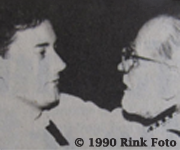
Unlike the other writers I’ve mention in this memoir series, I do not remember the first time I met James Broughton. I do however, remember two of the last times I saw him. One was captured in a photo by Rink, the well-known LGBT photographer at the OutWrite! writers’ conference in March 1990 in San Francisco in the 4 April 1990 edition of Outweek. James and I are in a closeup profile, with the caption: “Dangling Part(iciple)—Poet Bryan Monte is embraced by poet/filmmaker James Broughton.” The second recorded on a receipt from a Different Light Bookstore dated 11 November 1991 for a copy of Broughton’s Androgyne Journal and a notice of his reading the same evening.

Compared to five other writers, with whom I corresponded during that period, my missives to James were the most frequent and voluminous. Between 25 September 1985 and 2 November 1992, James sent me 18 letters or cards and sometimes books, whilst I (according to the Kent State University Special Collections where James’ later correspondence is kept), sent James ten communications in the form of postcards, letters and a review of his tapes series, True and False Unicorn and other poems, Songs from a Long Undressing, Graffiti from the Johns of Heaven and Ecstacies.

I don’t know if I’d met James when I lived in San Francisco the first time between 1980-84. I had certainly heard about him through Steve Abbott who told me about a boat cruise with a select group out on the Bay to celebrate James’ and his partner, Joel Singer’s union. I’d certainly read James’ poetry while working at the Small Press Traffic and Walt Whitman bookshops September 1983 to June 1984, both of which stocked his books of unabashedly gay, Whitmanesque, naked, cosmic, hippie poetry.

As far as I can determine, the first piece of our correspondence was a plain white postcard he sent dated 24 Sept 1985. I was then in the second year of my Masters degree in creative writing at Brown’s Graduate Writing Program. On this card, James wrote that he was surprised that I had moved to Providence and that he got my new address from a copy of No Apologies #4 which he found at Small Press Traffic Bookshop in San Francisco. He was happy to see that I was still publishing “gaily,” and wanted to know what I was “interested in printing.”

James went on further to ask if I had an address for John Landry so he could contact him. (James had contributed a poem, as I had, to Landry’s Collision magazine/anthology). James signed his name with a extended bar on top of the “J” and stamp with his name and address and, just to the left, another stamp of a petal-flamed sun looking towards his Mill Valley address. It felt like a ray of California sunshine in the midst of a cold, rainy Rhode Island autumn.

At the bottom of the card, James asked: “Do you have a copy of Ecstacies?” Either in San Francisco or after I arrived in Providence in August 1984 to attend Brown’s Graduate Writing workshop, James had given or sent me a signed copy of that book. In my letter of 20 November I told James I had “a beautiful, autographed” copy. I also told him I was swamped with work (writing poetry and putting together my MA thesis, working at the John Carter Brown library cataloguing rare German books and preparing my paper on the “homosexual” discourse in Fassbinder’s Berlin Alexanderplatz for the MLA convention in Chicago that December.

I told him I was missing California. I wrote: “I hope the sun is warm, the air tingles with a mentholated fog, and that you sit reading this letter in a eucalyptus grove.” I also enclosed a birthday present—a signed copy of No Apologies #5. I wrote that I hadn’t been able to locate John Landry, but an acquaintance at Brown, Natalie Robitaille, said she thought he was working up at the Plymouth Plantation exhibit at the national park. I asked James further if he was inquiring about the Collision anthology that Landry was editing in which I had some poems also.

In addition, I mentioned that I’d been a T. A. that summer for a film course up at a boarding school in Massachusetts and that their textbook mentioned James and his “several experimental films.” I told James: “I’ll have to re-read your poems now with a different eye to see how you manipulate your images from scene to scene.” I also told him I had to sign off because it was past 11 PM and I had a grant writing workshop to attend the next morning to try to get an NEA grant to help fund my magazine, No Apologies.

In a letter dated 12 December in response James said he had received the copy of No Apologies #5, which I had sent him and that he had “…enjoyed reading everything in it…” because it was “lively” and had a “fresh tone.” He also wrote that he “very much…would like to “send (me) …some material in January.” He continued: “I thought you knew had I been making films off and on most of life.” He sent a bio with a separate sheet of his films that were available through a distributor. He reported further that “Joel and I are doing fine…he is mostly making collages and I am working on my memoirs before I forget everything.” He ended the letter with “All my best wishes and tender regards,” wishing me a “Happy Christmas.”

In his next letter dated 17 Feb 1986, James apologized for being slow to respond to “your good letter.” (I don’t know if James is still referring to my letter of 20 November, or whether I wrote him another letter in between that date and his writing. His papers at KSU do not include a second letter from me). James had decided to submit some stories for consideration in the next issue of No Apologies. (That would have been issue #6. However, due to my financial situation as a working, sole-supporting graduate student, I wasn’t able to publish another issue of No Apologies). He sent “Two Tales for Fairies” and wrote “you can arrange them any way you wish.”

In the next stanza he mentioned he had “notes of all kinds for a chapter about the experience of my filmmaking.” Then he asked if I “would be interested…on how I made I made my first films in San Francisco in the late ’40s and ’50s?” Futhermore he wondered if my readers would know who “Maya Deren, Willard Maas and Parker Tyler” were because he had a piece “out at a cinema type magazine,” which if rejected, he would send to me.

I responded to James in a letter dated March 4, 1986 in which I thanked James for his submissions and accepted his poems, “Senior Scorpio’s Foxtrot” and “Off to the Lifelong Races,” and his film memoir, “Mother’s Day Goes Off to New York,” (which was currently under consideration by another magazine), for No Apologies #6.

I continued by asking James how his stay in Hawai’i had been. I mentioned I had been a newspaper intern there on Maui a few summers before. I also said that I liked his film memoir because of its metaphors which described a screening location for one of his films as having “the intimacy of a car barn in Siberia,” and in another place where he compared his film to “chamber music.” I told him: “Anyone who loves film should be interested in this piece.” I ended my letter by thanking him:

“for your invitation to keep in touch. It makes me feel good to know that people in the Bay Area miss me. I wish I could have been at your birthday party. It sounds like it was lots of fun. When I return to San Francisco, you’ll be the first person I’ll visit. Take care of yourself – and of Joel. Get back to me as soon as you can if the Mother’s Day piece is out of the running.

Around Christmas 1986 I sent James a card indicating I had a job teaching writing at a high school in semi-rural Massachusetts and that would be discontinuing publication of No Apologies. James responded with an undated card (probably from January 1987) the text of which read: “If it’s the last dance, dance backwards.” probably meaning to review what I’d done and look back on it with pride. In any rate, I felt supported and affirmed by James even though I wasn’t able to publish his pieces in my magazine. Inside he wrote: “Sad that we may lose No Apologies.” He hoped that things would improve for me and that I could start over again. He also asked if I would return his manuscripts.

The next piece of correspondence is my letter to James dated February 9, 1987. I told him I was able to locate his Mother’s Day manuscript in my correspondence binder, but not “the MSS of the two poems I accepted.” My happiness at receiving James’ card was also continued in the next paragraph when I told James I would visiting him the following week during one of the high school vacations. It was the first time I’d returned to San Francisco since I’d left in July 1984. (I’d also go through three blizzards in Massachusetts that winter before it was over). I told James that while in SF, I would be staying at Ed Mycue’s and Richard Steger’s apartment near City Hall and to give me a call. I added a handwritten P. S. and the bottom of my typed letter that read: “I’d really like to see you.”

During that holiday, I visited with Ed and Richard and with Steve Abbott and Thom Gunn. (In between I also looked for jobs in San Francisco through contacts in the the Brown Alumni Association. I was warmly received by a prominent SF hotel, a newspaper and a publication relations company. Each of these company’s reps. told me I would get a job if I returned that summer. I had a memorable dinner with James and Joel and Steve Abbott and Dennis Green at the couple’s 21st and Church Street hilltop apartment overlooking the lights of San Francisco. Joel cooked a lovely Italian meal, which I mentioned in my review.

Broughton poured wine and reminisced about his years in Paris and the Beat scene in San Francisco. Present was also Joel Singer, Broughton’s partner and artistic collaborator, who created the cover photomontages for Broughton’s new poetry tapes. Singer cooked an exquisite dinner of cheese gnocchi in gorgonzola sauce, osso bucco alla Milanese, and orange slices mascerated in Grand Marnier.

The same evening, James gave me his new, audiocassette collection which including recordings from his True and False Unicorn and other poems, Songs from a Long Undressing, Graffiti from the Johns of Heaven and Ecstacies to review. Either that evening or when I returned to Massachusetts, I gave or sent James a copy of Neurotika, my MA poetry thesis at Brown, which is included in Broughton’s KSU papers. At the top of the Neurotika MS is a handwritten note: “2.20.87 To James Broughton and Joel Singer, Thank you for your gifts of laughter and joy. Good luck and good health to you both! Bryan.”

The pleasant memory I have of visiting James and Joel at their SF apartment is reinforced by James’ postcard of his face in close up by Rink, dated and postmarked 28 February 1987. James wrote that he “enjoyed” my poetry and my visit and he hoped my “listening (to his tapes) had been productive.”

I responded with a postcard dated 3.8.87. “Dear James, I just finished my second draft of my review of your tapes. I will do the final draft tomorrow and Tuesday…Steve (Abbott) should have my copy by the end of the week.” I also continued on a personal note writing that: “I hope I can see you again this summer. Depending on the job possibilities, I may move back to SF. The West Coast isn’t Lotus Land, it’s the Promised Land! If I hadn’t gone to Brown for my MA in creative writing, I probably would have never left. I hope I can continue to teach writing (in SF).”

On 1 April 1987, I sent a copy of the review to Rudy Kikel at Bay Windows in Boston, who had just typeset Steve Abbott’s chapbook, The Lives of the Poets. I also informed him that Steve had sent copies to the San Francisco Sentinel and Poetry Flash.

In my review I wrote that: “Broughton is to be applauded for his return of poetry to its rightful medium—oral transmission. I remarked to friend once that reading poetry on the page is like trying to understand a song’s melody by reading the lyrics sheet.” I continued my review by praising Broughton’s tapes for their versatility and musicality. I mentioned his “The Water Circle,” which was set to a Corelli gigue.

I played this selection for my high school freshman, who were not the least bit reluctant to join in with Broughton the second time around. I used this poem as a springboard for their own poems about the natural elements and the seasons of the year. Another poem I played was “Mama is Gone.” It’s soft consonants and vowels echo a child’s lament….Broughton’s other “Songs for Anxious Children,” such as “Papa is a Pig” and Mrs. Mother Has a Nose,”…are strictly for adults due to their subtlety and subject matter.

I concluded that: “These tapes will surely establish James Broughton as one of the greatest (and one of the most underrated contemporary (American) poets….they will provide many hours of good listening.”

I don’t remember hearing back from Kikel about the review. Steve Abbott was also unable to place it at the Sentinel and Poetry Flash. James got back to me about a month later with an Uffizi Galleries postcard of Cranach’s Adam saying that he had read and liked my review of his tapes and wanted to know if I knew where else it could be published. He suggested The James White Review or The Advocate. He also invited me to dinner another time.

A little more than a month later, James sent me a typewritten note dated 8 June 87 with the epigraph “Garlic cures every infirmity/ except death where there is no hope.” Inside he wrote that he hoped I’d had “success in placing” the review because he thought it was “valuable and essential reading.” And he added an invitation saying that if there was a “festschrift for my birthday next year,” it or “another piece by you,” would certainly be welcome.

On 10 June 1987, I sent James a postcard of View from the Pilgrim Monument, Provincetown, Massachusetts. I thanked James “for your card of 4/28” and confirmed “I did enjoy writing the review of your tapes” and that “I’ve sent the review to Phil Wilkie at The James White Review.” I also said that I hoped “Joel’s show” had gone “well.” I also confirmed I would “like to come back for dinner” that I’d be out on the West Coast again “on the 20th of July for about a month.”

The next communication I received from James was on the back of a Pitti Galleries postcard of St. Sebastian by Giovanni Antonio Bozzi detto ill Vercelli. James wrote that he was “delighted” to see my review of his tapes in the JWR. “Praise and thanks.” He also wished me well.

By January 1988 I was living in Silicon Valley and working for an insurance company in San Jose. In order to learn the trade practiced by poet Wallace Stevens and composer Charles Ives, I was required to spend one evening a week in insurance classes for the next year and a half and to study at home for at least two hours every night in order to pass the three, four-hour written exams (included calculations which could only be done by hand) for my general insurance certificate. As a result of all this work and living an hour’s drive from San Francisco, I had to drop out of the literary life up North. I received an invitation from James for the premier of his new film, Scattered Remains, made in collaboration with Joel, at the Castro Theater on 26 March 1988, but I doubt that I attended. On the back of the invitation, James wrote his “Good wishes.” Later that year, in October, James kept his promise of inviting me to his schriftfest when he sent me an invitation to read at his 75th and Joel’s 40th birthday celebration at the San Francisco Art Institute on November 10, 1988. For that evening, I wrote and read the poem below:

Birthday blessings for James Broughton and Joel Singer
by Bryan R. Monte

A white house on the side of a hill
high above San Francisco’s lights
holds the home of two lovers and friends
we gather here to honor tonight.

A house of Beauty, a house of Mirth
where Love’s books are reinvented
cook, write, film, fuck, sleep
two lovers by Zeus’ cup demented.

A man and a youth they once began
almost thirteen years to this night
the young pupil and the wise teacher interchangeable
twin novitiates of androgyne delight.

For three days they stayed in bed
two lusty monks on spiritual retreat
and fed Love’s thirst through sweat and tears
sweet nectars of their bodies’ meat.

They taught their hands to sing Hermes’ hymns
to fashion a world for lovers’ delights
and wrought in film, photo, word and deed
the lives we celebrate tonight.

May we be eternally as silly as they:
forever as blessed
forever as blissed
forever as full of life.

On the copy in the KSU archives, I wrote at the top: “by Bryan R. Monte 11/10/88” and a personal note: “Happy Birthday! James & Joel. I hope you enjoy your new home up North.” The audience howled with laughter and applauded my poem, which was good. Just a few minutes before, though, I had mounted the stage with knees knocking so badly I didn’t know if I would be able to stand up and deliver my poem properly to the audience of nearly 300. It was good training. I was able to keep my nerves under control and it gave me extra confidence for my Walt Whitman Bookshop reading a fortnight later.

I invited James and Joel to my reading at the Whitman on a Friday towards the end of November. In response to my birthday poem and my invitation, James sent a postcard dated 17 November 1988 with a painting of “Shelly composing Prometheus Unbound in the Baths of Caracalla,” from a posthumous portrait in oils by John Severn from the Keats-Shelly Memorial House, Rome. He said he “loved” my “tribute,” asked for a copy and thanked me for taking part in his birthday celebration at the Art Institute, which he referred to as “our little vaudeville.” He also said he couldn’t make it to my reading because he had another appointment.

At the reading, I premiered some of the poems I’d written at Brown, including the long poem, Neurotika, about sexual longing, the AIDS crisis, and the probihitions against LGBT rights around the world with aural backing from Brian Eno’s Ambience. On November 28, I sent James and Joel a card with my best wishes. I told them I had had a good time at the Institute reading and his birthday party and I that enjoyed his films—especially Window Mobile, Shaman’s Psalm and the nude interview series, which I’d never seen before. I also told him that my reading “was quite a hit…there were about 25 to 30 people in the audience and my Neurotika piece caused quite a stir.” I also mentioned that: “I realize by now that you may be in Port Townsend. I hope your mail is being forwarded and that you receive this copy of the birthday poem, (and the picture of Joel I took last year at your house at the dinner party with my friend Dennis (Green) and Steve Abbott). Good luck up North and Happy Holidays.”

In response to my letter I received a card with two men on a bicycle, one doing a handstand on the handle bars, with the caption in the upper left “Please Stay in Touch with James & Joel” and their new address and postbox in Port Townsend in the lower left. On the reverse, James thanked me for my “delicious” poem and said he would put it “prominently” in in his “archive.” He also told me about his travel plans after Christmas which included stays in SF in April and June.

During 1989, James and I don’t seem to have corresponded. In September of that year I moved up from Silicon Valley back to San Francisco and into an apartment in the Mission at Valencia and 19th with a view of the apartment I shared with Harry Britt at 20th and Guerrero from April 1983 to July 1984. Here I wrote my weekly news stories and scripts and prepared questions for my bi-weekly interviews on KPFA’s weekly Wednesday night Lavender News on the Fruit Punch radio hour. From this base (and my day job as a computer technician in SF’s Financial District), I trawled the Castro for the LGBT news alone or with photojournalist Rink. I covered demonstrations, AIDS memorials, protests, school board meetings, baseball games, art exhibtions, etc.—anything of interest to the queer community. Every other week I interviewed gay writers, politicians or commentators such as Stan Leventhal or John S. James.

At this time that I also began attending poetry and prose readings in the Mission, the Castro and Berkeley. I started my own weekly writers workshop with regulars such as Donna Kreisle Louden, Edward Mycue, Ronald Linder, Richard Linker and Andrea Rubin. It was Ed in fact, who, according to my 11 November 1989 journal enry, told me about a reception for James on Green Street and said that my invitation had probably been sent to my old address in Silicon Valley.

My journal entry for that evening reveals clearly the happiness and beauty that surrounded James and Joel’s lives and their willingness to share that with me.

James greeted me wearing his ubiquitous pin-purple square oriental pill box hat, a light blue scarf tied around his neck and a darker, blue cordurouy shirt. He put out his arms immediately (to embrace me) . . . The first thing he said was: “It’s a been a year since I’ve seen you; a year exactly.” He was right. He told me I looked good. I told him him he was (as) full of life as ever and as always, happy. He told me he worked at being blissful every day

Joel asked me if I’d like to go to dinner later and I said yes. We ended up with about six people in our party: Hal Hershey, a Berkeley book designer, John Carr, critic for the BAR, Michael Hathaway who hosted the party for James that afternoon and, of course, James, Joel and myself…(at) a Japanese restaurant on Fillmore and Union. We sat upstairs around a low table and I was on James’s right hand. Joel described some Native American ornamentation he’d painted onto the side of their new house. (I also heard that Joel is working on a series of watercolours…He says they’re in the style of photomontages). I asked James the secret of his longevity, but he just smiled.

My training as a radio journalist gave me good training for my writing. From the press releases, books and reading and event announcements, I was aware of what was going on in the gay community. All this, of course, was happening whilst the AIDS crisis was decimating the LGBT community. At least once a month I announced the death of a prominent man or woman I had known personally who had died of AIDS. In addition, one quarter of my radio stories were about AIDS fundraisers and support groups. I felt useful providing this information weekly to the gay community. And it helped me hone my skills as a writer to go out and get stories, sift the facts from the gossip or outright lies, and shape it into the type of telegraphic language necessary for radio news. I soon discovered that for every minute on air, I needed to spend at least an hour preparing my script either at home or gathering information “on location.”

The next piece of correspondence I sent to James and Joel is a letter dated January 6, 1990 from my Mission District apartment. I wrote “It was a pleasure to see both of you during your recent visit to San Francisco. I enjoyed having dinner with you at the Japanese restaurant and listening to James read at the Intersection. I hope both of you had a good holiday. (Did you throw a winter solstice party?) I had a great time on Christmas and New Years. On the first holiday, I went to the Fruit Punch party, and on the second, my roommate and I hosted an open house in our apartment.” I enquired further about their welfare and asked if “Joel is still painting Native American designs on your new house?” and “How is Special Deliveries coming along?” I asked James when his book came out to send me a review copy since “I’m doing 10-20 minutes of news, reviews and interviews on Fruit Punch.” I ended the letter saying that I was thinking of travelling North to Port Townsend with Rink to visit James and Joel.

James responded about three weeks later with a This is It Syzygy Press poetry postcard dated 26 January 1990. James wrote he had just returned for the Yucatan with Joel and that he was working on the final proofs for Special Deliveries.

The next time I saw James was at the OutWrite! Writers’ Conference in San Francisco in March 1990. I covered the conference, speaking with Allen Ginsberg in addition to James.

James Broughton and the author, OutWrite! Writers’ Conference, San Francisco (March 1990). Photo by Rink © 1990. All rights reserved.

James Broughton and the author, OutWrite! Writers’ Conference,
San Francisco (March 1990). Photo by Rink © 1990. All rights reserved.

In response to the above photo in the 4 April issue of OutWeek, James sent me another postcard of a 60+ man logging crew standing on top or next to an enormous tree trunk which it is strapped to a semi-wagon saying that he liked Rink’s photo of “beauty and the old beast.” He wrote would be sending a review copy of Special Deliveries and would be in town for Gay Pride at the end of June to read. He signed the postcard: “Big Log.”

Once again there is a gap of at least a year when James and I did not correspond. During this time, I moved from my flat in the Mission to one in the Outer Sunset from which I could hear and see the Pacific Ocean’s breakers. Here I had hoped to get away from the problems of the City, especially the AIDS crisis. A receipt from A Different Light Bookstore from 11 November 1991 indicates I purchased James’ Androgyne Journal the morning of his reading, and his signature in the book along with the message “for Beloved Bryan. Rejoice in Oneness with Love. James” indicates that I must have attended, but unfortunately I have no journal entry for this day, nor any memory of James’ reading.

Unfortunately, it was also at my oceanview apartment that my new boyfriend, who I’d met in April 1991 and moved in by July, coughed through Christmas with pneumocystis. During the holidays, my new, next-door neighbour abandoned his apartment to die in the arms of his family. By February, my boyfriend was in hospital. Then one Friday evening I came home from work and found he had moved out without giving notice or leaving a forwarding address. In addition, the things he’d left behind were scattered around the flat, including a plant whose soil he’d swirled over the white livingroom carpet.

After my ex-boyfriend left, I kept the AIDS crisis at bay by teaching four times a week after work—twice a week to Russian émigrés out in the Avenues and once a week each to technical writing students at the University of California Extension and to my own writers’ workshop in my living room. Previously this moonlighting had been contractually forbidden by my daytime employer, but once the company went from 17 to 12 to seven to five offices in four massive reorganizations in two and a half years, no one cared as everyone scrambled to find new jobs before they lost their old ones and their homes or apartments.

I remember driving home on night from the UC Extension’s Menlo Park campus at 11 PM along I-280 in thick fog. I was so tired I had rolled down the window and turned the radio up so that the cool air and loud music would keep me from falling asleep behind the wheel. I also remember coming home one night at 10 PM, surprised to feel I was choking as I ate my supper hot out of the oven only to discover I still had my tie on that I’d put on for work that morning at 7 AM. The death of my neighbour, the impending death of a second ex- and the loss my job, all of this was on my mind when I corresponded with James in 1992, one year before I was forced to leave S.F. because I couldn’t find a full-time job or combine two or three jobs that would pay the bills.

The first missive is from James dated 23 January 1992 on James Broughton’s Port Townsend stationery and sent in a Holiday Inn Aeropuerto envelope. He welcomed my suggestion that Rink and I visit him and Joel up North, but he said he couldn’t host us at the moment because he had a family visiting for one month and “some brutal dental surgery” the next. He also reminded me that it was a two-day drive from San Francisco to Port Washington. He ended his letter with “I love you & send you my love & welcome too. Be sure to flourish. Joy from James.”

I must have sent James another letter talking about putting together my poetry collection because I received a postcard of a young man with a muscular torso and legs holding a mirror dated 2 March 1992. It announced a visit by James to San Francisco in “mid-May” and said he “hope(d) you are getting it (the poetry collection?) all together.”

Then about a month and a half later, I received a flyer from James in an envelope postmarked 16 April indicating his readings and screenings in May. On the 14th James had a reading at the Art Institute sponsored by the Cinematique and City Lights Books. The flyer also mentioned that besides the readings, signings and parties, two of Broughton’s films, Scattered Remains and Dreamwood would be shown. James wrote a personal note on the flyer indicating the precise dates he would be in San Francisco and a telephone number in town.

I don’t know if I saw James this time. I may have because I sent him an update of my poetry collection that I had first sent in 1988. This Neurotika, however, was twice as long as the first because it included my performance piece of the same name about the AIDS epidemic.

James responded on 2 Aug 1992. He wrote I had packed a lot into my book because he thought it was really “two different” books: the first poems and the second part the “prose paragraphs of the Neurotika section” which he felt “is almost of a book of its own…an impressive picaresque elegy.”

Broughton’s critique of the poetry (first) section was that it: “…often dropped words so the sense of the line is unclear…” He suggested I “not capitalize” (the beginning of my) lines so it would be easier to distinguish when a new sentence occurs.” He reassured me, however, that: “You have a genuine gift for nuance and impression, for phrasing and shaping.”

He also commented that he was “a hard-hearted reviser” of his own writing and that he was now on his third revision of his memoirs. He advised me: “when in doubt, cut.” Broughton’s letter ended on an encouraging note: “You have enormous potentiality….”

I responded to James’ letter on the 10th thanking him “for your suggestions, especially those concerning the (non)-capitalization of (the first word in) my lines” and for his encouraging words about the Neurotika section. I also asked if he would provide a book blurb.

On November 2, I received the following blurb from James: “Neurotika does not belie its title. On the contrary it pushes sexual neurosis to painful lengths…The neurotic fear of sex that pervades governments and communities around the world provides a concurrent theme. This is a sad, savage, sorry chronicle.”

By that time I had “finished” Neurotika, however, I had lost my job. I had to choose between staying in the City and living from my unemployment benefits and free-lance teaching (which, unfortunately, wouldn’t pay three-quarters of my expenses) and to self-publish Neurotika from my savings, or pursuing my vision of a new life in the Netherlands, which I had had since I was a graduate student.

I purchased an Apple PowerBook laptop and a journalist quality camera and applied for teaching jobs in the Netherlands. Luckily, just after my job ended in San Francisco, I got a job in the Netherlands as an Apple computer system administrator and a substitute English teacher, which is how I began my now 23-year stay.

From James I learned the ropes of writing business—both backstage and on stage. Through his correspondence and books, he taught me how to improve my visual communication as well as my word choice. He provided opportunities for me to create and present work, and, through his and Joel’s hospitality, I learned the value of good food, conversation and company. As a result of this, the time I spent with James and Joel were some of the happiest and most fulfilling I experienced as a writer in San Francisco in the 1980s and ’90s during a very dark period for the LGBT community.